
By Emily Greenhalgh
Article | November 9, 2026
What can a blood test tell us about our risk of developing cancer? Could changes in our eyes reveal early signs of Alzheimer's disease? What can the cells in our bodies tell us about how we're aging?
At The Jackson Laboratory (JAX), researchers are exploring these questions and more. While the research spans different diseases and areas of biology, there's a common thread: biomarkers.
What exactly is a biomarker?
A biomarker, short for biological marker, is a measurable characteristic that can provide clues about what's happening inside the body. Some biomarkers (like blood pressure, cholesterol, and blood sugar levels) are already well understood and familiar parts of routine medical care. Others are far more complex, involving subtle changes in our DNA, proteins, cells, or tissues that scientists are only beginning to understand.
“Whether it’s a new diagnosis, a family history, or changes that come with age, shifts in health bring uncertainty. People are often left wondering: What is this? What comes next? What should we do? Biomarkers help us start to answer those questions by measuring what we can’t otherwise see, and that allows for more personalized care,” said Melissa Kelly, clinical laboratory director in JAX’s Advanced Precision Medicine Laboratory.
What can biomarkers tell us?
Biomarkers can serve different purposes depending on what scientists or clinicians are measuring. Some help identify people at greater risk of developing certain diseases, while others can help diagnose conditions, predict how a disease might progress, determine whether a drug or treatment is working or likely to work.
To discover new biomarkers, scientists look for biological differences between healthy and diseased cells, tissues, or individuals. But finding a difference is only the first step. Just because a biomarker is identified, it doesn’t mean it can be used to diagnose that disease or be used to identify a treatment. Before it can be used in care, researchers have to show that the test gives consistent results, that it truly reflects what is happening in the body, and that knowing the result actually helps patients get better care.
At JAX, researchers are investigating how biomarkers could help identify the earliest signs of disease, often long before symptoms appear.
Can the eyes be a window to the brain?
In 2025, JAX Professor Gareth Howell and his team found that changes in the retina could offer clues about brain aging, potentially providing a less invasive way to identify early signs of neurological disease and cognitive decline.
“By the time someone is diagnosed with Alzheimer’s disease, the disease may have been developing for decades. If it was feasible to discover relevant biomarkers at an eye exam rather than a brain exam, we would have a huge advantage to identify those that were at risk of developing Alzheimer's,” said Howell. “By leveraging mouse models that mimic human genetic risk, we can better understand the biological mechanisms that underlie age-related vision loss and neurodegeneration—and potentially use the retina as a biomarker for overall brain health.”
The team, led by Associate Research Scientist Alaina Reagan, identified changes in retinal blood vessels in mice carrying a genetic mutation common in humans. These changes, which included twisted vessels, narrowed arteries, and reduced branching, are associated with poor blood flow in the brain and cognitive decline. Their publicly available dataset could help researchers further investigate connections between eye and brain aging, with implications for earlier detection of diseases like Alzheimer’s.
While Howell's team is investigating changes in the eye that could reveal clues about brain health, other JAX researchers are looking for early warning signs of disease in our blood.
Can aging blood cells signal disease risk?
JAX Professor Jennifer Trowbridge and her team study hematopoietic stem cells, the cells in our bone marrow responsible for continuously producing new blood cells throughout our lives. As we age, these cells can acquire mutations that allow certain cell populations to expand, a process known as clonal hematopoiesis. Although this process does not necessarily lead to cancer, it is associated with an increased risk of developing blood cancers, including leukemia.
Trowbridge's team is investigating the genetic, epigenetic, and cellular changes that distinguish normal aging from those that may be early warning signs of disease.
“Everyone’s blood changes as they age. At present, we can’t distinguish between changes that are harmless and those which are early warnings of blood cancer,” said Trowbridge. “Our goal is to learn that difference, so that one day a person at risk could be identified years before disease develops, while there’s still time to slow it or stop it.”
Recent research from the Trowbridge lab found that precancerous blood cells can accelerate aging in the surrounding bone marrow, creating conditions that favor their own growth. Understanding these changes could help researchers identify biomarkers of blood cancer risk and uncover new opportunities for earlier intervention and prevention.
Across JAX, other researchers are investigating biomarkers that could help reveal everything from how the immune system responds to disease to the biological changes associated with healthy aging.
From biological clues to better patient care
While researchers work to discover new biomarkers, others at JAX are already helping guide patient care.
“Biomarker testing can be used at many stages — diagnosis, treatment, monitoring response, and survivorship. It’s a dynamic process,” said Lindsey Kelley, a certified genetic counselor and associate director of the Maine Cancer Genomics Initiative (MCGI).
Founded in 2016, MCGI helps bring cancer biomarker testing and precision oncology expertise and access to clinicians across Maine, one of the nation's most rural states. In cancer treatment, biomarker testing can reveal important differences between tumors, helping clinicians identify therapies most likely to benefit individual patients. By identifying specific biomarkers, doctors can determine whether FDA-approved treatments are available for a patient's particular cancer or explore other options, including clinical trials investigating new targeted therapies .
Through its Genomic Tumor Boards, MCGI also provides oncologists real-time help understanding biomarker test results. This helps them use complex information to make better treatment choices, and brings personalized cancer care to patients outside major research hospitals.
Beyond MCGI, JAX's Clinical Education team develops training and resources to help healthcare providers across the globe understand cancer biomarkers, genetic testing, and precision oncology. By helping makes sense of this complex information, JAX is working to improve access to biomarker-informed care in more places.
What's next for biomarkers?
While not every promising biomarker will become a clinical tool, each discovery brings researchers closer to understanding how diseases develop and how that knowledge could ultimately improve patient care.
As scientists uncover more about the biological changes associated with health and disease, biomarkers could help shift medicine from treating diseases after symptoms appear to identifying risks earlier, making more precise diagnoses, and developing more personalized treatments.
Animations: Caroline Bennett, The Jackson Laboratory .
Learn more
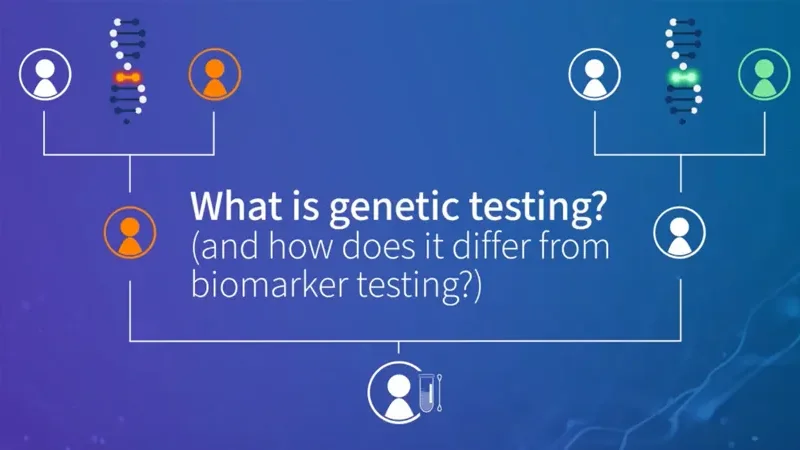
Unlocking cancer clues with genetic testing - The Jackson Laboratory
Genetic testing aids cancer prevention and treatment by identifying DNA changes. Hereditary tests assess inherited risks, while biomarker tests guide targeted therapies.
View more
Understanding biomarker testing
Learn about biomarker testing, its role in cancer care, and how it helps guide personalized treatment options.
View more