
Pre-cancerous blood cells may fuel disease risk by prematurely aging the bone marrow
By Roberto Molar Candanosa
Article | August 6, 2026
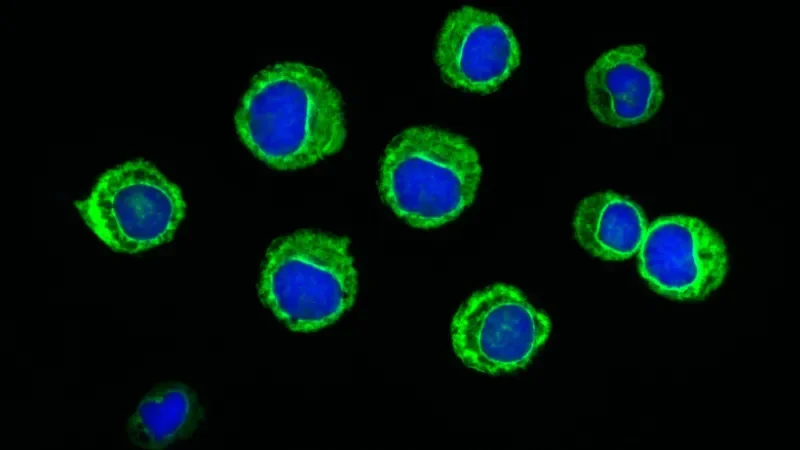
Pre-cancerous blood cells can actively reshape their surroundings, prematurely aging cells in the bone marrow to create conditions that favor their own growth and, potentially, increase the risk of blood cancer, according to a new study by researchers at The Jackson Laboratory (JAX).
The findings challenge long-held assumptions about aging and how pre-cancerous cells expand, and point toward a future strategy for cancer interception: targeting the aging bone marrow environment to help slow down or prevent blood cancers before they arise.
The study, which used mouse models and human samples, appears today in Nature Cell Biology. It also shows that these aging cells can accumulate faster than normal, leading to far more of them than would be expected for a person’s age.
“We usually think of these senescent or aging cells as something that just accumulates with chronological age,” said study author Jennifer Trowbridge, JAX professor and Dattels Family Chair. “What we’ve shown here is the first example that clonal hematopoiesis can actually accelerate that process. It creates senescent cells in the bone marrow environment faster than you’d expect for someone’s age.”
The work focused on clonal hematopoiesis, an age-related condition where mutations allow certain blood-forming stem cells to produce an outsized share of the body's blood cells over time. Scientists call the resulting population a “clone,” a large family of cells descended from a single mutated ancestor.

Clonal hematopoiesis affects roughly one in five people over age 70. Although it is not cancer, some mutant clones are considered pre-cancerous because they can sometimes acquire additional mutations and progress to blood cancers. The condition has also been linked to increased risks of cardiovascular disease and stroke. This has made scientists increasingly interested in fully understanding why these clones expand and what determines whether they remain benign or progress toward disease.
"By understanding how some of these indicators of aging arise in the bone marrow and how stem cells can develop into blood cancers, we're beginning to appreciate that many other players are involved, including different cell types and biological processes,” Trowbridge said. “That knowledge could help us identify much earlier who is at the greatest risk of developing blood cancer. It also gives us new ideas for how to stop or slow the disease before someone is ever diagnosed.”
For years, the prevailing theory was that mutations made pre-cancerous blood cells more fit than normal cells, allowing them to expand over time. The new research suggests that is only part of the story. The mutant cells also appear to create an environment that helps them flourish.
Instead of examining only the mutant blood cells, the researchers analyzed gene activity in individual bone marrow cells in mouse models and human samples. The team discovered that the mutant blood cells altered nearby mesenchymal stromal cells, a type of support cell that helps regulate blood production inside the bone marrow. The stromal cells showed signs of cellular senescence, an aging-like state in which cells stop functioning normally but remain alive and release chemical signals that alter the behavior of nearby cells. These “aged” support cells created conditions that favored mutant blood cells over healthy ones.
Next, the researchers tested whether removing senescent support cells could strip mutant blood cells of the advantage they appeared to gain from the altered bone marrow. Across multiple tests, clearing senescent cells reduced the expansion of mutant blood clones. Mice with fewer senescent stromal cells also showed slower progression toward blood cancer.
In other words, rather than passively responding to mutant blood cells, the bone marrow appears to play an active role in helping pre-cancerous blood cell clones expand and progress toward disease. If the bone marrow is a garden and a mutant blood cell is a weed, scientists used to think the weed simply outcompeted the flowers because it grew faster, said study author Jayna Mistry, a former postdoctoral fellow in Trowbridge’s team. What they found is that the weed also changes the soil, making it harder for healthy flowers to thrive and easier for the weed to take over.
"When we treated the soil directly, the weed lost some of its advantage,” said Mistry, who is an assistant professor at the University of East Anglia and Norwich Medical School. “This suggests you don't only have to fight the weed, you can also treat the soil."
While more work will be needed to determine exactly which signals drive stromal cell senescence in humans, the findings point to a different approach to cancer prevention. By disrupting the interaction between mutant blood cells and the aged bone marrow environment they create, it may be possible to slow or prevent the progression of clonal hematopoiesis toward blood cancer.
Beyond blood disorders, the findings may have implications for other age-related diseases and cancers. Because mutated cell populations arise in many tissues, including the skin, colon, and esophagus, the researchers plan to study whether similar interactions between mutant cells and their surroundings help drive disease elsewhere in the body.
“There are many conditions where, if you have this happening in your blood, you're more likely to be at risk of developing those diseases,” Trowbridge said. “What we're showing is a mechanism by which that may happen, one that might contribute to all of those other diseases, too. The common part is that root cause. If we can target the root, we could, in theory, delay or prevent any of those diseases in an aging population.”
Trowbridge is the chair of stem cells and developmental biology research at JAX.
Other authors are Kira A. Young of JAX; Anna Navarro Figueredo of the Technical University of Munich; Gibran Edun and Alicia G. Aguilar-Navarro of Princess Margaret Cancer Centre; Patricia A. Colom Díaz and Maria Telpoukhovskaia of JAX; Inés Fernández Maestre and Sheng F. Cai of Memorial Sloan Kettering Cancer Center; Katharina S. Götze of the Technical University of Munich; Anastasia N. Tikhonova of Princess Margaret Cancer Centre; and Ross L. Levine of Memorial Sloan Kettering Cancer Center.
This work was supported by NIH grants R01DK118072, R01AG069010, and U01AG077925; an EvansMDS Discovery Research Grant; the NIH/NCI Cancer Center Support Grant P30CA034196; the Memorial Sloan Kettering Cancer Center Support/Core Grant P30CA008748; Blood Cancer United (formerly the Leukemia & Lymphoma Society); The Dattels Family Endowed Chair; The Jackson Laboratory Scholar Award; the Mark Foundation for Cancer Research; a Scholarship of Excellence from Rafael del Pino; the NCI F99 Award (CA284253-01); the European Research Council through the European Union's Horizon 2020 Marie Skłodowska-Curie Innovative Training Network (MSCA-ITN, Grant Agreement No. 953407); the Canadian Institutes of Health Research (PJT-203948, PJT-180406); a Tier II Canada Research Chair; the Princess Margaret Cancer Foundation; and the Ontario Institute for Cancer Research.
JAX media contact: Patrick Skahill, 860-839-3309, [email protected].
Learn more about The Jackson Laboratory.
Citation: Mistry J.J., Young K.A., Figueredo A.N., et al. Stromal Cell Senescence Augments Hematopoietic Cell Fitness in Clonal Hematopoiesis. Nature Cell Biology. 2026. doi: 10.1038/s41556-026-02025-4.
Learn more
Supercharged mitochondria spark aging-related blood disorders
JAX researchers found a common Dnmt3a mutation boosts blood stem cell mitochondria, driving clonal hematopoiesis tied to heart disease and blood cancers.
View more
The Trowbridge Lab at JAX
The Trowbridge lab studies hematopoietic stem cells, aging, leukemia, and epigenetic regulation to identify biomarkers and new therapies.
View more