Optimize your time and results in therapeutic candidate selection when you partner with the JAX Preclinical Services team. Experience a seamless workflow with innovative mouse models paired with JAX study services to advance your drug pipeline in immunology, autoimmune and inflammatory disease. No matter what class of therapeutic you're exploring, JAX customized study solutions can support and de-risk your project - from lead optimization to IND filing.
Design your studies with confidence when you include JAX models for autoimmune disease and immunology. Choose from some of the most well-published models in the world as a foundation, and push forward with our latest platforms, developed by our team of scientific experts dedicated to development models that support new insights.
| Model | Relevant Disease | Description |
|---|---|---|
BALB/cJ | Psoriasis | The advantage of this model over other inducible psoriasis models is the fast induction of clinical phenotypes for rapid therapeutic screening. |
MRL-Lpr | Lupus | Recapitulates more clinical features of human SLE than other mouse strains. This model has been used extensively in preclinical efficacy studies. |
NZBWF1/J | Lupus | Model is routinely used for JAX preclinical services. Autoimmunity is characterized by high levels of antinuclear antibodies, hemolytic anemia, proteinuria, and progressive immune complex glomerulonephritis. |
NOD/ShiLtJ | Type 1 Diabetes | Recapitulates spontaneous development of Type 1 Diabetes. |
PBMC Engrafted | Immunology | PBMC models support short term characterization of human T cell function or longer-term immuno-oncology studies. |
CD34 Engrafted | Immunology | CD34 models support longer studies and demonstrate diverse mature immune cell populations. They are ideal for evaluating mechanism of action and antibody-dependent cellular cytotoxicity. |
JAX Preclinical Services are managed by experienced Study Directors and staff dedicated to helping you obtain the critical data needed for your research. See the sample study data presented here, and inquire with us about customized studies to suit your project goals.
Efficacy Study for Cyclophosphamide (Cytoxan) treatment in MRL-lpr Mice
Therapeutic dosing was evaluated to include development of autoantibodies (anti-dsDNA), proteinuria, and tissue pathology scoring in JAX Model MRL-lpr, which is homozygous for the lymphoproliferation spontaneous mutation (Faslpr). The model phenotype includes systemic autoimmunity, massive lymphadenopathy associated with proliferation of aberrant T cells, arthritis, and immune complex glomerulonephrosis.
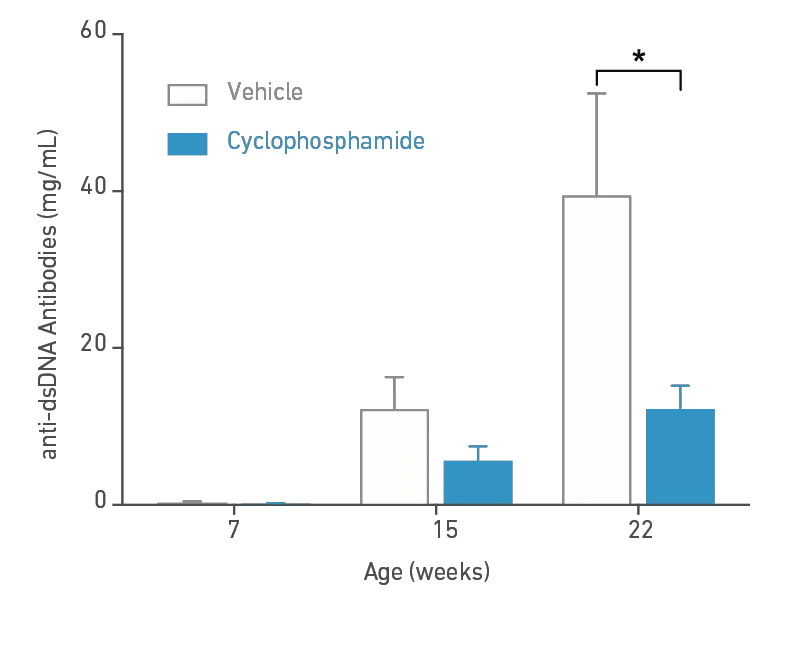
MRL-Lpr Model (000485)
Anti-dsDNA Antibody Concentration in Sera. Serum anti-dsDNA antibody levels can be reduced with cyclophosphamide treatment in MRL-Lpr mice. *p<0.05
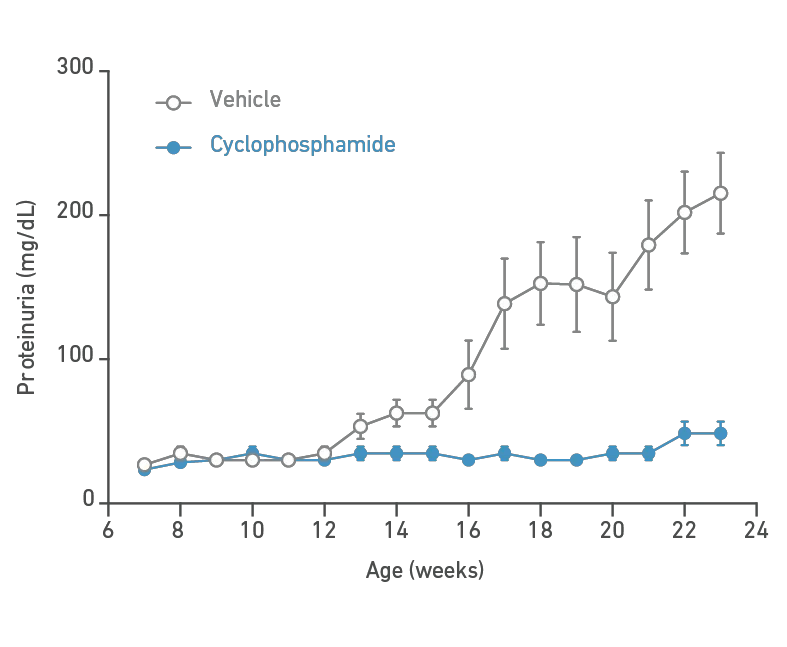
MRL-Lpr Model (000485)
Proteinuria Analysis. Proteinuria begins to increase by 13 weeks of age. Treatment with cyclophosphamide beginning at 8 weeks inhibits the increase in proteinuria in MRL-lpr mice.
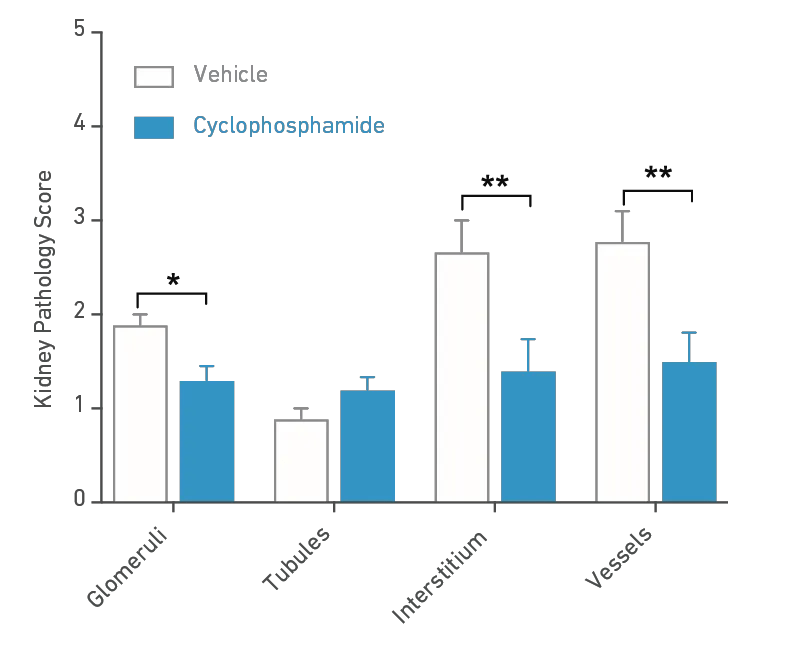
MRL-Lpr Model (000485)
Kidney Pathology Analysis. Histopathology scoring of different regions of the kidney shows improvements following cyclophosphamide treatment in MRL-lpr mice.
*p< 0.05, **p< 0.01
The Jackson Laboratory provides many inbred and mutant mouse strains that are appropriate for the study of several common autoimmune disorders. These include spontaneous and induced models of disease.
In this webinar, you'll learn about JAX models that can be applied to Lupus, Psoriasis, Type I Diabetes, and Multiple Sclerosis research, along with tips to identify other strains that may be well-suited to your projects.