Aging & cancer: Modeling the puzzling link
Article | June 8, 2026
Yet even among people of the same age, cancer risk varies widely — raising a fundamental question for scientists: Why do some bodies remain resilient while others become vulnerable?
While scientists know cancer risk increases with age, what remains far less clear is how the aging process itself reshapes the body in ways that allow these tumors to thrive. To tackle that challenge, JAX scientists are attempting to study cancer in a way that has rarely been done before.
The Genetic and Aging Influences on Neoplastic Susceptibility (GAINS) project uses large‑scale, genetically diverse mouse cohorts to profile naturally occurring tumors in two-year‑old mice (the equivalent of an elderly human). GAINS could help reveal how the immune system responds to cancer differently with age, why some individuals develop cancer while others of the same age don’t, and how one’s DNA influences their risk of developing cancer as they get older.
Support JAX research
Your gift makes it possible for discoveries to happen faster, for novel ideas to be explored and for research to accelerate forward at a scale that delivers life-changing scientific breakthroughs.
Tracking cancer one cell at a time
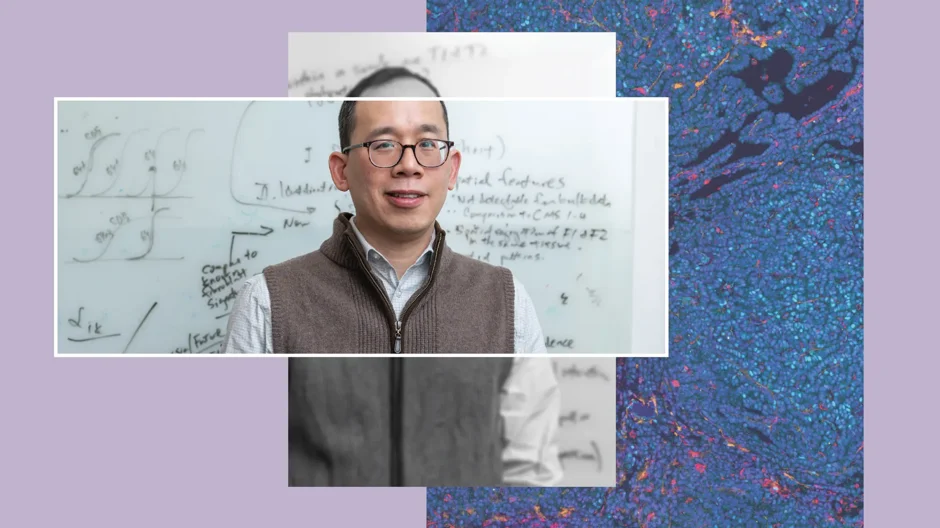
Led by JAX Professor and Donald A. Roux Endowed Chair Jeffrey Chuang and JAX Professor and Evnin Family Chair Ron Korstanje, GAINS has already profiled 2,500 tissue abnormalities in more than 1,000 aged and genetically unique mice. Early observations revealed that liver and lung were the most common kinds of tumors. In one of the groups, reproductive system tumors were the most frequent in females, while prostate tumors were rare in males.
In many studies, mice are bred to be pre‑disposed to the type of cancer the researchers want to study. But the GAINS project only studies naturally occurring tumors.
“It’s surprising that we are seeing these spontaneous abnormalities because we simply didn’t know whether these mice would develop them. We didn’t breed these mice to get a certain kind of tumor,” Chuang said.
The team is analyzing cells and tissues with advanced imaging techniques that allow them to make observations at single-cell resolution. With the help of machine learning, they can quantify and classify how individual cells behave as tumors emerge and develop.
With JAX Professor and Dattels Family Chair Jennifer Trowbridge, they are also studying how blood stem cells change with age, since these cells can impact the immune system’s response to cancer.
We know very little about how aging changes the body in ways that can actually be targeted for treatment. We need to know those specific processes so we can target them with therapies.
Jeffrey Chuang, Ph.D.
The team is also comparing their samples to human data, and plan to share their research with the scientific community to help improve treatments for cancer patients.
“That’s what we’re very excited about, because clinically we still have much to learn about why people get different kinds of tumors,” Chuang said.
From solid tumors to blood stem cells, these approaches are helping scientists understand why cancer becomes more common with age and opening new possibilities for preventing the disease before it begins.
Featured in Search
Search magazine is a publication from The Jackson Laboratory focused on research discovering and human health.