
JAX recognizes outstanding postdocs with 2025 Scholar Award
News Release | February 5, 2025
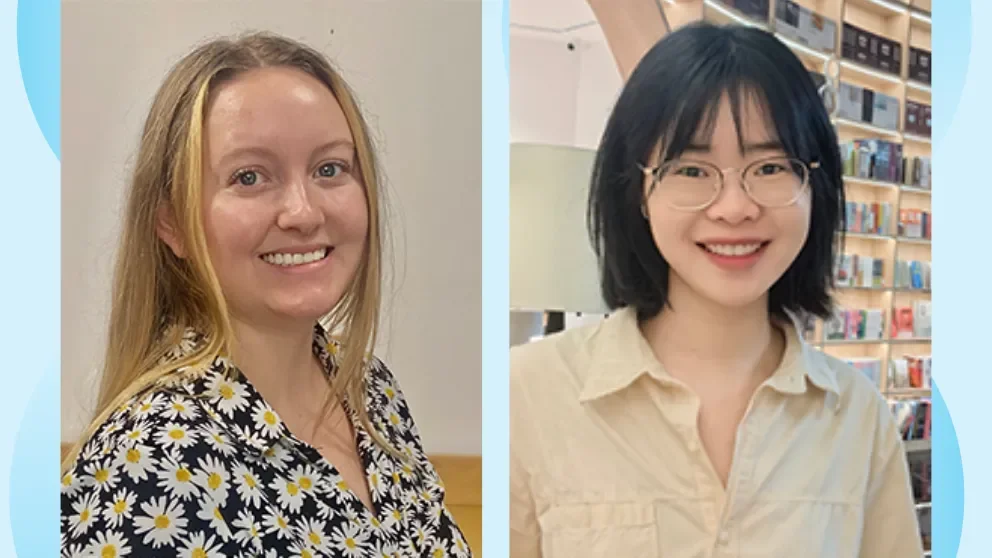


Two postdocs honored for their contributions to the genetics behind stem cells, aging and circadian rhythms.
(Bar Harbor, Maine – Feb. 4, 2025) – The Jackson Laboratory (JAX) announced today Xiurong Cai, M.D., and Gretchen Clark, Ph.D., as recipients of the 2025 JAX Scholar Award. The fellowship supports outstanding postdoctoral associates as they advance the understanding of mammalian biology and human disease.
“All of our postdocs make meaningful contributions to the advancement of our understanding of the complex diseases impacting our family, friends, and neighbors,” said Meredith Theeman, Ph.D., director of predoctoral and postdoctoral education. “Drs. Cai and Clark exemplify the value in assembling an interdisciplinary group of scientists from different academic backgrounds who can leverage their collective knowledge toward successful research discoveries.”
Both scholars have overcome challenges, including the COVID-19 pandemic, and have found a supportive and collaborative environment at JAX that has been instrumental in their scientific process and training experience. Looking ahead, they plan to continue their translational research to make a tangible difference in human health. Below is a glimpse of their career, journey, research and future aspirations.
Xiurong Cai, M.D.

Xiurong Cai studies how hematopoietic stem cells – self-renewing cells found in our bone marrow – grow and change as we age, and what this means for our health. As a postdoc in Jennifer Trowbridge’s lab, Cai is looking at how specific genetic changes in these stem cells can increase the risk of developing blood cancers. Her goal is to find new ways to keep our blood healthy and prevent diseases like heart disease, dementia, and blood cancers.
Ever since Cai began her journey in research, she has seen science as a series of connections. She initially trained to be a physician as a medical oncology major at the Third Affiliated Hospital of Sun Yat-sen University in Guangzhou, China, However, Cai was continually drawn to the realm of basic science, where she could delve into the finer points of research and then translate those findings into medical advancements.
In 2018, Cai pursued an M.D. at the Charité–Berlin University Medicine affiliated with Humboldt University in Germany. While studying there, she shifted her focus from lymphoma and began exploring the field of hematology. Cai found inspiration studying immunotherapy, a field that can provide hope to cancer patients. She became particularly interested in how chemotherapy-induced senescence – the process that occurs when cells ‘age’ and stop dividing – could make patients more susceptible to the benefits of immunotherapy.
Cai was eager to keep moving, learning and making connections in the lab and with other scientists conducting research that might inspire her own. But the COVID-19 pandemic arrived, bringing many challenges, including missing out on the international conferences that facilitate networking and collaborations. Cai kept a keen eye out online, where she discovered an advertisement for a postdoctoral position in Jennifer Trowbridge’s lab at JAX, which studies the development and maintenance of hematopoietic stem cells. Trowbridge's expertise, and the lab's collaborative atmosphere was incredibly appealing. She applied and joined the lab in February 2024.
“Dr. Cai brings a strong background and expertise in tumor immunology and immunotherapies to our research group,” said Trowbridge. “I’m excited to see how she integrates this expertise into her postdoctoral studies on clonal hematopoiesis to generate transformative breakthroughs in this field.”
At JAX, a supportive environment and spirit of collaboration continue to be cornerstones of Cai's scientific process and training experience. With encouragement from her mentor, Cai has found many ways to connect with others from utilizing JAX’s extensive scientific service offerings, to taking part in the workshops, seminars and social events, including a memorable whale watching trip – complete with views of the stunning Maine shoreline. At JAX, she said, there are ongoing efforts to bring the community together, as well as to provide access to insights from visiting scientists from all over the world.
Looking ahead, she envisions securing a faculty position to continue focusing on translational research; always on the lookout for those elusive connections that yield a tangible, translatable finding that can make a difference to those who need it most.
"I love research," Cai said. "You propose a question, conduct your first experiment, and then there are more questions. You search for the answers that have already been discovered, propose your own theories, and you keep working until that project becomes an important contribution to the scientific community.”
Basic science, she acknowledged, is challenging, with many trials along the way. But knowing that that next experiment may yield that answer for a patient in need – that’s what keeps her going.
"About 99 percent of basic science research may not be translated directly," she said. "Only one percent holds the potential for major breakthroughs. But we must acknowledge the valuable experience gained from the other 99 percent.’’
Gretchen Clark, Ph.D.
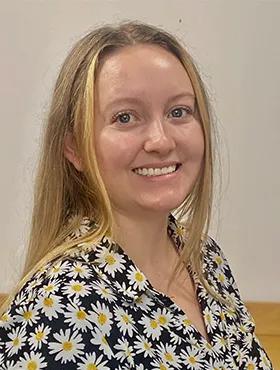
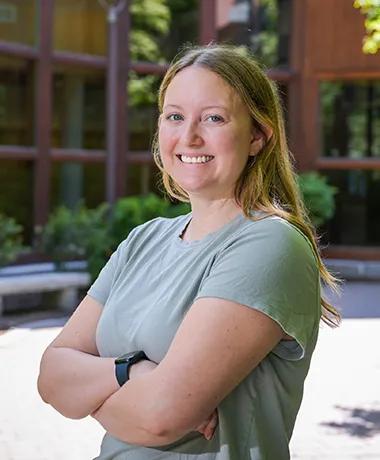
Gretchen Clark revels in the finer points of scientific discovery: the intricacies of experiments and how new studies in her realm of research might inform her own. But to Clark, a postdoc working in Nadia Rosenthal and Ron Korstanje’s labs at JAX, a crucial part of the process lies beyond the paper publication, in communicating that science to those beyond the lab. She is motivated to share discoveries with the people who can benefit from them.
Clark capitalizes on JAX’s wide range of biological models that better represent human genetic differences to study the complex process of cellular senescence and its beneficial and detrimental impacts on aging. Cellular senescence can spur inflammation that aids in regeneration and growth, and it is crucial for processes like muscle regeneration and cancer suppression. However, as we age, it can also seed chronic inflammation, leading to age-related diseases such as heart disease, chronic kidney disease, and Alzheimer’s disease. Clark is determined to uncover how this happens, the variation across different cell types and if we can harness this knowledge to improve human health. The challenge lies in understanding how to fine-tune this process.
Always eager to explore all sides of the scientific story, Clark is working on several significant projects in this arena. One, in collaboration with the Mayo Clinic, investigates how the genetics of an individual can increase or decrease their age-related senescence susceptibility. By using fibroblasts from a panel of mice that mimic the wide range of human genetic differences, Clark is inducing senescence in a variety of ways to determine gene variants that increase the risk of age-related senescence. Another project focuses on the use of senolytic drugs, which are thought to remove senescent cells. Most of these drugs have only been tested on a single strain of mice, but through the Interventions Testing Program (ITP) at JAX, Clark and colleagues are expanding this research to include a wide variety of different strains to determine how effective these drugs are across different genetic backgrounds.
A third project integrates her previous doctoral work on circadian rhythms at Rensselaer Polytechnic Institute – a true passion for Clark – with her current research on senescence. Her graduate work was among the first to provide a potential link between circadian disruption and amyloid accumulation in Alzheimer's disease.
Now, as a JAX postdoc, she is studying several strains of HET3 mice at various ages and collecting samples at different times of the day, she aims to understand how the daily patterns of gene expression in aging cells change across different organs. This has fueled her passion for continuing to explore aging and circadian rhythms and makes her a rising expert in this exciting field. She is always on the lookout for ways to collaborate with peers at JAX, and from other institutions, as well, including being a member of the Cellular Senescence Consortium, where she works with other experts to map these processes in both mice and humans.
“Gretchen is a real self-starter and hit the ground running upon our arrival. Her passion for circadian rhythm research is infectious and we’ve both become sensitized to the need to control for the time of day (or night) in our mouse colonies under observation,” said mentors Rosenthal and Korstanje in a joint statement.
What’s next? "Trying to communicate what we are learning is my biggest passion moving forward," Clark said. She is dedicated to making her findings accessible to those who need them most (for instance, shift workers whose circadian rhythms are often disrupted) and passionate about translating the often easily accessible preventative measures evident in her scientific studies – such changes to diet and light exposure – that could make a huge difference in people’s health.
"I don't know what field I’ll end up in, but I always want to be working on something that will help someone," she said. "If we aren't producing work that's going to help people, I haven't done my job."