
An Advanced PBMC-Humanized NSG-S15-DKO Mouse Model for Comprehensive Evaluation of Immunotherapeutics
By Charu Gupta, Ph.D., Senior Technical Information Scientist
Blog Post | June 16, 2026
What You'll Learn:
PBMC models enable in vivo human immune system studies
Delayed GvHD supports longer, more flexible study windows
NSG-S15-DKO shows:
Enhanced multi-lineage engraftment (T, NK, myeloid, functional B cells)
Sustained immune functionality (e.g., IgG production, NK activity)
Improved modeling of complex immunotherapy responses
Engraftment of human peripheral blood mononuclear cells (PBMCs) into severely immunocompromised mice, such as NOD scid gamma (NSG) and related strains, has become a cornerstone of preclinical research for evaluating immunotherapeutics (Ye et al. 2020, Morillon et al. 2021, La Rochere et al. 2018). These models enable in vivo assessment of both safety and efficacy, providing critical insight into whether candidate therapeutics should advance to clinical trials. Importantly, they also facilitate the early identification and mitigation of potential immune-mediated toxicities in patients.
Immunotherapeutics, including chimeric antigen receptor T cells (CAR-T), CAR-NK cells, and monoclonal antibodies (mAbs) comprise a diverse class of agents designed to modulate the immune system by targeting antigens on either immune cells or malignant cells. The predictive value of PBMC-humanized mouse models in assessing these therapies depends heavily on the extent and composition of immune cell engraftment, including the representation and functionality of different immunophenotypes such as T, NK, myeloid, and B cells. It is worth noting that donor-to-donor variability can impact which cells engraft and to what extent (Ye et al. 2020).
The conventional PBMC-engrafted NSG mouse model is characterized by robust T cell engraftment but demonstrates several limitations. B cells are present – with transient peripheral blood localization – but largely dysfunctional, with no de novo and minimal memory IgG production. Myeloid and natural killer (NK) cells exhibit only transient persistence in peripheral blood. Furthermore, these mice develop graft-versus-host disease (GvHD), which significantly limits their lifespan and restricts their utility for long-term studies of immune activation. Although modifications such as adjusting PBMC dose or no irradiation can modestly extend study duration, these approaches remain insufficient for many oncology and autoimmune research applications (King et al. 2009).
To address these limitations, NSG mice lacking both mouse major histocompatibility complex (MHC) Class I and Class II molecules (NSG MHC I/II double knockout, DKO) were developed (Ye et al. 2020). PBMC engraftment in these mice results in delayed onset of GvHD, extending the experimental window to approximately three months. However, this effect is donor-dependent, necessitating pre-screening of PBMC donors. While T cell engraftment is somewhat reduced compared to conventional NSG mice, it remains functionally sustained. Nonetheless, B cell dysfunction and the transient nature of myeloid and NK cell populations persist.
Both conventional NSG and NSG MHC I/II DKO models are valuable for studying T cell activation and suppression, supporting the evaluation of T cell-based therapies such as CAR-T cells, CD3 bispecific antibodies, and immune checkpoint inhibitors. These models can also be applied to investigate B cell-targeting therapies (e.g., CD19- or BCMA-directed agents). However, two major limitations remain:
Immunotherapeutics often engage immune cell populations beyond T and B lymphocytes.
The efficacy of these therapies in solid tumors may be constrained by limited lymphocyte infiltration into tumor tissue.
To overcome these challenges, a next-generation model was developed by combining the NSG MHC I/II DKO background with human cytokine-expressing NSG-SGM3-IL15 mice. The resulting strain, NSG-SGM3-IL15-MHC I/II DKO (NSG-S15-DKO), incorporates homozygous expression of human stem cell factor (SCF), GM-CSF, IL-3, and IL-15, alongside knockout of mouse MHC Class I and II. This genetic configuration enhances the engraftment, persistence, and functionality of a broader range of human immune cells while maintaining delayed GvHD onset following PBMC transplantation.
PBMC-engrafted NSG-S15-DKO mice support engraftment of a diverse array of immune populations, including:
T cells: CD3+, CD4+, CD8+, and rare γδ T cell subsets
Myeloid lineage: CD33+ progenitors
Dendritic cells: CD11c+ conventional dendritic cells
Natural Killer cells: CD56+ NK cells
B cells: CD19+, CD38+ memory IgG-secreting cells and CD138+ spleen-resident plasma cells
This model uniquely supports sustained engraftment of T, NK, myeloid, memory and plasma B cells, enabling long-term immunological studies that were previously not feasible. Compared with NSG-MHC I/II DKO mice, the NSG-S15-DKO model demonstrates several key advantages:
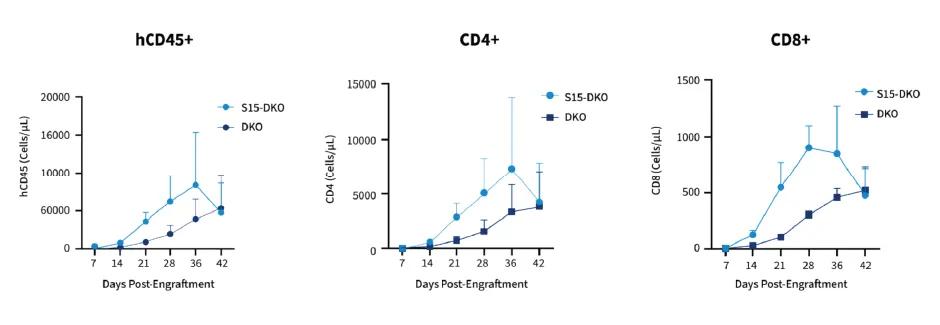
Enhanced T cell engraftment: Higher levels of human CD45+ T cells enable studies requiring greater cell abundance, such as in vivo CAR-T cell generation, without the rapid onset of GvHD seen in standard NSG mice (Figure 1).
Figure 1: S15-DKO engrafts high levels of human CD45+ and T cells.
S15-DKO mice were engrafted with PBMCs from 3 donors. Mice were retro-orbitally bled every week to evaluate CD45+ cells and CD4+ or CD8+ T cells as a percentage of CD45+ cells in peripheral blood via flow cytometry.Expansion of rare T cell subsets: Improved engraftment of γδ T cells, which are of growing interest due to their lack of MHC restriction and potential as off-the-shelf therapies with minimal GvHD risk (JAX Poster: AACR 2026)
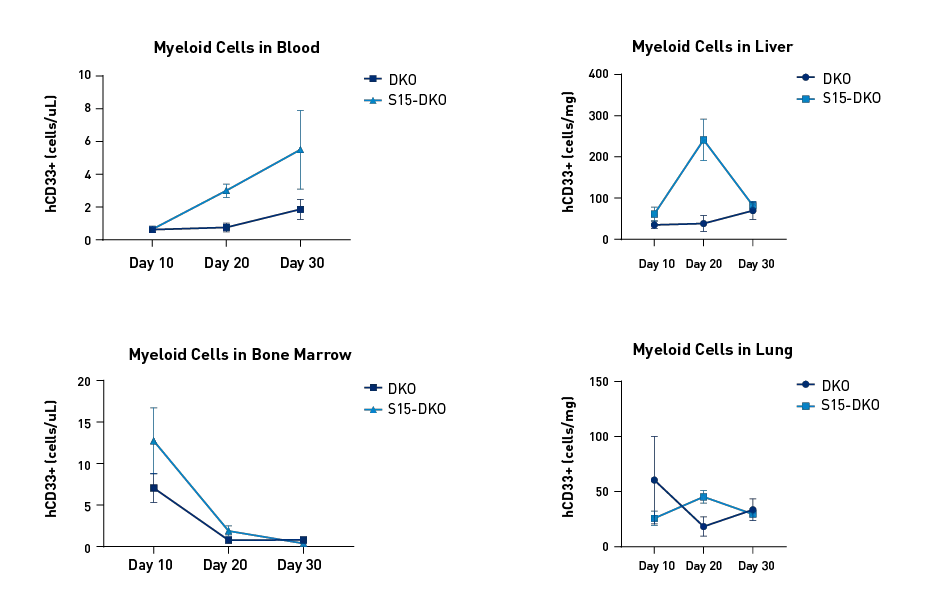
Improved myeloid cell persistence: Increased tissue-resident myeloid cell populations in blood, liver, spleen, and lungs. Conventional dendritic cells show strong splenic localization, supporting studies of myeloid trafficking and activation, when employing a myeloid cell engager (Figure 2)
Figure 2: S15-DKO engrafts high levels of tissue resident myeloid cells.
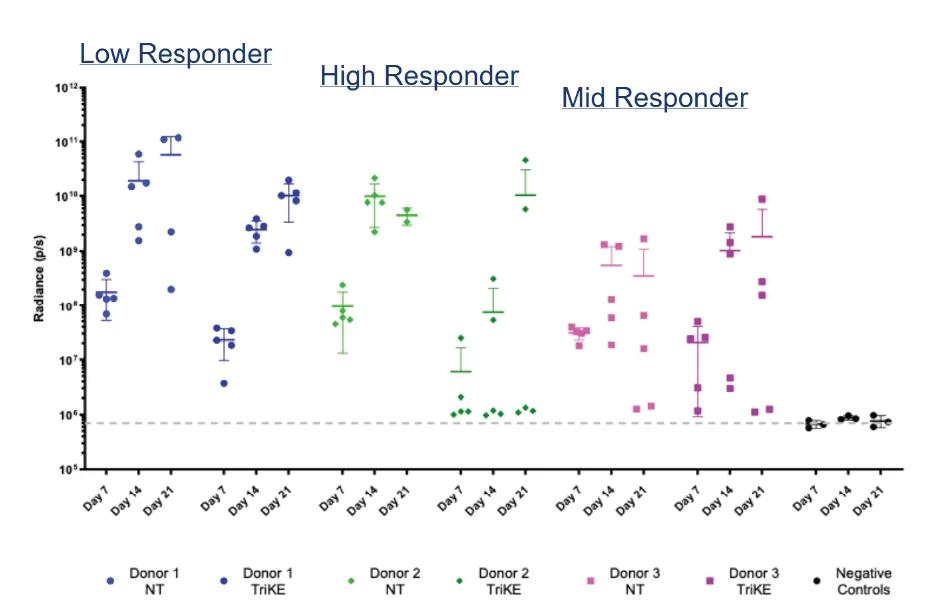
S15-DKO mice were engrafted with PBMCs from a single donor. Mice were sacrificed at days 10, 20 and 30 to evaluate CD33+ cells as a percentage of CD45+ cells in whole blood, bone marrow, liver, and lung via flow cytometry.Sustained NK cell activity: NK cells persist and remain therapeutically targetable, for example with trispecific killer engagers (TriKEs), even at later time points post-engraftment (Figure 3)
Figure 3: S15-DKO can be used to model donor variation to therapeutic responses for NK cells.
S15-DKO mice received an intravenous (IV) injection of Raji-luc (75,000) cells at day -1, followed by an IV infusion of normal donor PBMCs (10,000,000) at day 0. Mice started CD19-targeting TriKE treatment (50 μg/injection intraperitoneal) at day 0 and were dosed 3 times a week throughout the course of the study. Tumor load was assessed through bioluminescent imaging (BLI), post-luciferin injection, at days 7, 14, and 21.Functional B cell responses: Increased numbers of B cells with broader tissue distribution, including CD38+ memory B cells and CD138+ plasma cells. These populations exhibit sustained functional activity, including measurable IgG production following antigenic stimulation (JAX Poster: AACR 2026)
Additionally, co-engraftment of human tumor cell lines in this model further enhances immune cell expansion and persistence compared to non-tumor-bearing controls, supporting its utility for tumor immunology and therapeutic efficacy studies (JAX Poster: AACR 2026).
The NSG-S15-DKO PBMC-humanized mouse model represents a significant advancement over conventional and earlier-generation NSG platforms, addressing key limitations that have historically constrained the translational relevance of preclinical immunotherapy studies. By combining delayed GvHD onset with robust, multi-lineage human immune cell engraftment, including sustained T, NK, myeloid, and functional B cell populations, this model enables a more comprehensive and physiologically relevant evaluation of immunotherapeutic agents. Its capacity to support long-term studies, capture complex immune interactions, and facilitate assessment across both hematologic and solid tumor contexts positions it as a powerful tool for next-generation drug development.
Importantly, the NSG-S15-DKO model expands the scope of investigational possibilities beyond T cell-centric approaches, allowing researchers to interrogate therapies that engage diverse immune compartments and to better model mechanisms of efficacy and toxicity. When paired with pre-characterized PBMC donors and tumor co-engraftment strategies, it offers a scalable and reproducible system that reduces variability and enhances experimental predictability. Collectively, these attributes make the NSG-S15-DKO model a valuable platform for advancing immunotherapy discovery, de-risking clinical translation, and ultimately improving study outcomes.
View our catalog of cell humanized mouse models for immuno-oncology research here.
Additional Resources
Blog: Immune Cell Humanized Mouse Models: PBMC Engrafted Mice
References
Ye et al., 2020. A rapid, sensitive, and reproducible in vivo PBMC humanized murine model for determining therapeutic-related cytokine release syndrome. PMID: 32772418
Morillon et al., 2021. The Development of Next-generation PBMC Humanized Mice for Preclinical Investigation of Cancer Immunotherapeutic Agents. PMID: 32988851
La Rochere et al., 2018. Humanized Mice for the Study of Immuno-Oncology. PMID: 30077656
King et al., 2009. Human peripheral blood leucocyte non-obese diabetic-severe combined immunodeficiency interleukin-2 receptor gamma chain gene mouse model of xenogeneic graft-versus-host-like disease and the role of host major histocompatibility complex. PMID: 19659776