
JAX recognizes outstanding postdocs with 2026 Scholar Award
Article | March 31, 2026
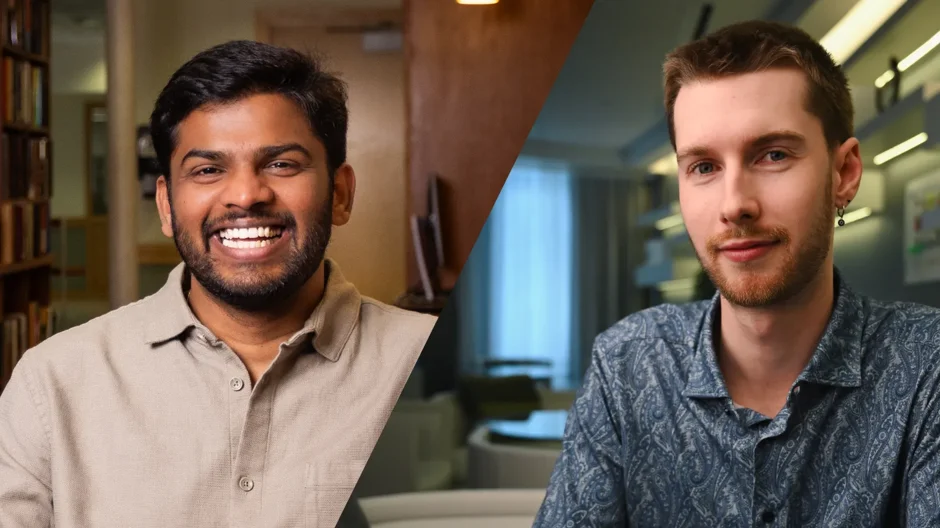
(Bar Harbor, Maine) – The Jackson Laboratory (JAX) has announced Luke Trinity and Arunachalam Sekar as recipients of the 2026 JAX Scholar Award. The fellowship supports outstanding postdoctoral associates as they advance the understanding of mammalian biology and human disease.
“Amongst a strong group of postdoctoral trainees, JAX Scholar Award recipients stand out for their innovative approaches to complex questions,” notes Meredith Theeman, director of predoctoral and postdoctoral education. “With thoughtful expert mentorship from their PIs, Arunachalam and Luke are leveraging the significant scientific services and resources available at JAX to push our collective knowledge forward with the goal of improving human health.”
Arunachalam Sekar
Danger from within: how damaged mitochondria drive heart failure
Arunachalam Sekar, a postdoctoral associate in Phillip West’s lab, is conducting groundbreaking work uncovering how damaged mitochondria contribute to heart failure. His research addresses one of the most fundamental questions in medicine: how the cell’s own energy‑producing structures can become powerful triggers of inflammation and tissue damage.
Mitochondria are essential for powering every cell in the body, and the heart, one of the most energy‑demanding organs, is densely packed with them. When mitochondria become damaged, they release internal components that act as danger signals, activating immune pathways that can kill healthy cells. This process underlies complications in cancer therapy, rare mitochondrial diseases, cardiac aging, and heart failure. Sekar’s work aims to identify exactly how this cascade unfolds and to uncover new strategies to protect the heart before damage becomes irreversible.
Sekar says his scientific motivation is rooted in understanding this destructive cycle at a mechanistic level. “When mitochondria, the ‘powerhouse of the cell’ gets damaged, it triggers a chain reaction of inflammation that destroys the heart. I want to understand exactly how that happens and develop treatments to stop it in children with rare mitochondrial diseases, cancer patients whose hearts are damaged by chemotherapy, and aging patients,” he explains. “JAX is one of the few places where you can study all three of these together, and that unique environment is what makes this work possible.”
His research interests solidified during his doctoral training when he examined a neglected question in cancer biology regarding the harm that treatments themselves can cause. “Not how to kill the cancer, but what the treatment does to the patient,” Sekar says. His team discovered that steroids used during chemotherapy for pediatric bone cancer could accelerate tumor growth. “That taught me to look at the problems nobody else is looking at, which is exactly what brought me to JAX, studying how chemotherapy silently destroys the heart in the patients it is saving.”
Looking ahead, Sekar is driven by the potential for long-term impact. “When you protect a child with a mitochondrial disease or pediatric cancer from heart damage, you are not adding months. You are adding decades. That child gets to grow up,” he says. “That is the scale of impact I want my research to have, and JAX is where I am building the foundation to pursue it.”
Luke Trinity
Aging at the cellular level: how to treat immune system changes as we age
Luke Trinity, a postdoctoral associate in Duygu Ucar’s lab has been recognized with this research award for his innovative work uncovering how the epigenomes of human hematopoietic stem and progenitor cells change with age. His research focuses on understanding why the immune system becomes less effective, more inflamed, and more prone to dysfunction as people grow older. That question has major implications for healthy aging, vaccine design, and treatments for age‑related disease.
Trinity is currently leading two projects that shed new light on how chronic viral exposure and vaccination reshape the immune system.
The first project centers on cytomegalovirus (CMV), a widespread herpesvirus carried by roughly half of adults by age 40. Despite its prevalence, scientists still lack a complete picture of how lifelong CMV infection alters immunity, particularly in older adults. Trinity and his colleagues conducted the largest study of its kind to map how CMV influences immune cells at the single‑cell level. The work revealed specific T‑cell populations that expand in CMV‑positive individuals and led Trinity to develop CMVerify, a machine‑learning tool capable of accurately determining whether a person has been exposed to CMV using only single‑cell data. These findings highlight how CMV may accelerate aspects of biological aging and underscore the importance of accounting for CMV status in studies of the aging immune system.
“We are working to shift aging adults towards improved lifespan and healthspan (time of life in good health). In our work we have found that cytomegalovirus takes a toll on the immune system and generally remains poorly understood,” he says. “Our study leverages machine learning and AI to introduce a novel tool that will help disentangle aging- versus CMV-driven immune signatures in older adults.”
Trinity’s second project investigates why the recombinant zoster vaccine (RZV), used to prevent shingles, is so effective in older adults, particularly compared with other vaccine options. By analyzing multiple layers of immune data, his team discovered that RZV induces long‑lasting immune changes, including months‑long shifts in gene activity in monocytes. These durable effects may be driven by “trained immunity,” in which stem cells are reprogrammed to produce functionally altered immune cells. Trinity is now examining how these stem and progenitor cells change with age, with early findings showing elevated inflammatory proteins in older adults and age‑linked shifts that may hold the key to understanding chronic inflammation in aging.
As Trinity continues his work at JAX, his research is helping redefine how scientists understand immune aging, advancing both fundamental biology and future strategies for improving health across the lifespan.
Learn more
Postdoctoral Research Training
Conduct cutting-edge research on the complex diseases impacting human health as a Postdoctoral Associate at The Jackson Laboratory.
View more
Spotlight on the 2025 JAX Scholars
From the lab bench to long-term goals, postdoctoral scientists Xiurong Cai and Gretchen Clark talk about what fuels their curiosity and how JAX supports their path forward.
View more