
Modeling disease cell by cell
Article | November 6, 2025
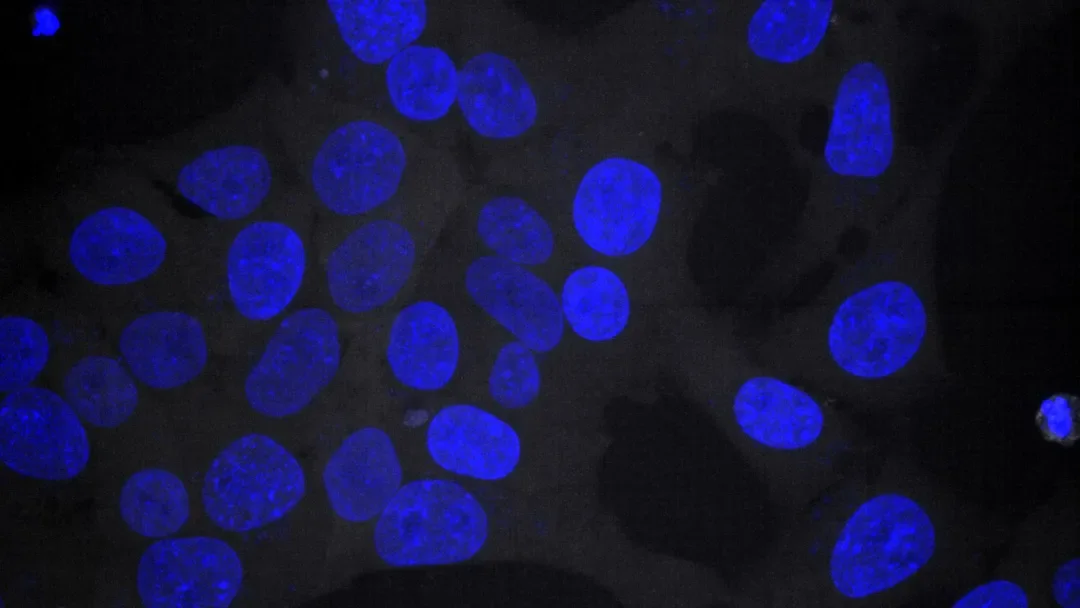
How JAX scientists are using stem cells to build better models, faster insights and smarter treatments
JAX has long been recognized as a global leader in biomedical research for its pioneering work in genetics, genomics and the development of mouse models that have transformed our understanding of human disease. But JAX’s expertise doesn’t stop at the organismal level. In recent years, JAX researchers have been at the forefront of advances in stem cells and cell modeling.
Central to that effort are induced pluripotent stem cells (iPSCs). “What I love about iPS cells is that they are normal, diploid human cells — unlike cancer cell lines, which were used for decades to try to infer human biology and are highly abnormal,” said Bill Skarnes, JAX professor of cellular engineering.
“You can differentiate iPSCs into virtually any cell type of the body. That flexibility is what makes them so powerful.”
Skarnes’s lab uses genome-editing technology to model disease in stem cells and share these resources with JAX researchers and the broader scientific community. By introducing precise genetic mutations (often single-nucleotide changes linked to disease) and guiding the cells to become neurons, immune cells, or other relevant tissue types, researchers can study how those mutations function in a biologically accurate setting.
“What used to be an incredibly slow and laborious process has become much more efficient,” said Skarnes. “Now we can introduce mutations with high accuracy and scale that process up.”
His team has worked with the NIH to model more than 150 patient-derived mutations, including those related to Alzheimer’s disease and other dementias.

From a dish to patients
For JAX Professor Martin Pera, who has long worked at the interface of stem cell biology and disease, the shift to high‑throughput, cell‑based models marks a turning point.
“JAX has always been known for its mouse models,” he said. “But these stem cell platforms help us study disease genetics more precisely — and in ways that complement what we learn in vivo.”
The result is a research engine that spans from cell cultures to living organisms, positioning JAX to capture a fuller, more nuanced picture of how disease begins, unfolds, and might one day be stopped.
“JAX is uniquely positioned to bridge the results from cells in a dish to a whole organism to, ultimately, human patients,” said Pera.
“JAX has never been about the mouse. From the very start, the mouse was a path toward a bigger goal: a future free of disease,” said JAX Chair Emeritus David J. Roux. "Now, with the combination of mouse, cell and computational models, that path that began in Maine nearly 100 years ago has become a high‑speed highway of discovery.”
Scope, speed, scale
The pace of research continues to accelerate as JAX scientists adopt automation and data‑driven tools to manage the growing complexity of cellular biology.
“As you go to higher throughput, you need machine learning,” said JAX Associate Professor Sasan Jalili, whose lab uses patient‑derived samples, organoids, and “organ‑on‑a-chip” technologies to build personalized systems that help understand disease mechanisms and test therapies. “We are focused on bridging the gap between in vitro models and real-world disease, using cutting-edge technologies to create more accurate and dynamic models of human disease.”
“The volume of data from these systems is enormous,” said Jalili. “That’s where AI and data science come in. They help us extract meaningful patterns and insights that would otherwise be impossible to see. Our efforts are aimed at making these tools more accessible to scientists around the world, ensuring that insights gained from our models can directly inform therapeutic development and patient care.”
With NYSCF, JAX is poised to scale up that vision.
“NYSCF has developed automated systems that really speed the rate at which we can do this kind of research,” said Skarnes. “It signals a real commitment by JAX in the human cell model space.”
Learn more

JAX-NYSCF Collaborative
The Jackson Laboratory’s acquisition of the New York Stem Cell Foundation unites complementary strengths across mouse, cell and computational models.
View more
Scope. Speed. Scale.
The bold new alliance between The Jackson Laboratory (JAX) and The New York Stem Cell Foundation (NYSCF) promises to transform biomedical research and bring life-changing therapies to patients faster than ever before.
View moreFeatured in Search
Search magazine is a publication from The Jackson Laboratory focused on research discoveries and human health.