
A cellular view of an ovarian tumor
July 16, 2025
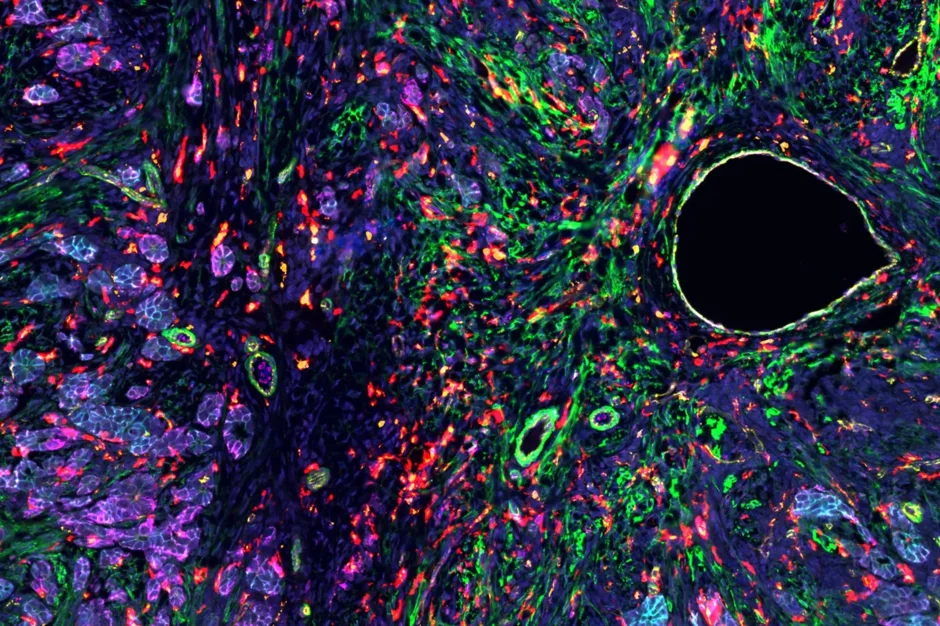
View a high resolution version of this image.
What am I looking at?
This is a rare type of tumor called Sertoli-Leydig tumor, which makes up fewer than 0.5% of all ovarian tumors. Though rare, Sertoli-Leydig tumors can cause significant hormonal imbalances. All tumors are heterogeneous. That means they’re made up of lots of different types of cells all working together. This colorful image shows the tumor tissue at the single-cell level. Each color highlights a different cell type within the tumor’s complex microenvironment.
Cutting-edge imaging tools like single-cell sequencing can help scientists visualize and understand how cells work together (or against each other) in a tumor environment.
The blue ovals are the nuclei of individual cells. Yellow highlights the endothelial cells that form blood vessels, while magenta and cyan mark different types of epithelial tumor cells. The green strands represent myofibroblasts and perivascular cells—supporting cells often involved in tissue remodeling. Orange spots show macrophages, a type of immune cell that helps clear debris, and red marks antigen-presenting cells, which help alert the immune system to potential threats.
How was this image captured?
This image was captured using the multiplex antibody-based single cell spatial proteomics platform phenocycler fusion 2 (Akoya) in the JAX Single Cell Biology Lab.
About the Single Cell Biology Lab
The Single Cell Biology Laboratory (SCBL) at JAX helps scientists explore tissues one cell at a time. Using cutting-edge tools like single cell spatial proteomics, transcriptomics and single-cell sequencing and functional 'omics, the lab reveals how cells interact in both healthy and diseased tissues. Researchers work closely with the lab team, which is made up of talented and highly skilled wet lab and computational members in every part of the process from planning experiments to analyzing data in order to get the most from these powerful technologies. The SCBL, led by Director and Senior Research Scientist Elise Courtois and co-led by Associate Directors Bill Flynn and Kuo-Chang Hung, contributes to national efforts like Cellular Senescence Network (SenNet) and the Human BioMolecular Atlas Program (HuBMAP), helping map human biology in unprecedented detail.
Learn more
Single Cell Biology
The Single Cell Biology Laboratory applies cutting-edge technologies to interrogate molecular and cellular features at single-cell resolution. Services include high-throughput single-cell transcriptomic, epigenetic, and multiomic profiling; spatial transcriptomics; multiplexed RNA in situ hybridization and hyperplexed antibody-based imaging of analytes in situ; and automated, imaging-based high-content screening of cellular phenotypes for large-scale assays. UConn investigators can access our services through the JAX–UConn Single-Cell Genomics Center agreement.

News and Insights - The Jackson Laboratory
Gain insights into bioscience, technology and the quest to improve human health.
View more