
The better to hear you: Unlocking secrets of the inner ear
Article | August 4, 2025
The human ear does more than just detect sound. It tells us where our body is in space, helps us judge distance and direction, and guides our social behavior by telling us to lean closer to hear a friend’s secret or to heed warning shouts from a crowd. In short, hearing plays a crucial role in how we experience the world.
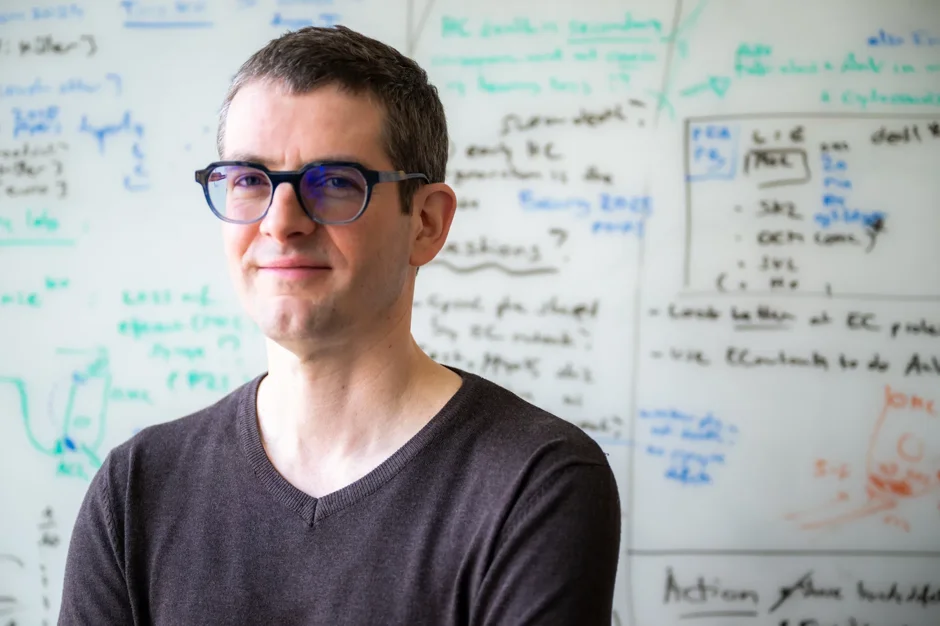
What happens to us, then, when we lose our ability to hear? Basile Tarchini, Ph.D., associate professor and inner-ear researcher at The Jackson Laboratory, explores that question from an architectural angle, studying the molecular mechanisms that shape inner ear development to understand changes in its structure over time. His work could provide clues on how to unlock hearing regeneration potential in aging adults, and how to restore hearing following injury.
“We’re approaching hearing loss from a developmental biology perspective,” Tarchini said. “The only way to coax these sensory cells into fixing themselves, either through repair or regeneration, is to understand how they came about in the first place. You have to start at the source.”
Sound receptors are few, fragile and non-regenerative
Humans are born with all the sound receptors, also known as hair cells, that we will ever have in our lifetimes — about 16,000 per ear that are susceptible to harm and cannot regenerate. Heavy machinery, construction work and repeat exposure to loud noises all pose environmental threats to the hair cells of the inner ear. Once these cells die, we never get them back.
In the United States alone, the age-65+ demographic is expected to grow to 82 million people by 2050. With humans living longer than ever, the impact of hearing loss on the brain and body is an ever-growing health concern. Accidents, social isolation and even cognitive decline stem from a decreased ability to hear and understand what’s happening in the world around us. Tarchini’s research could help develop therapeutics and interventions to mitigate those challenges.
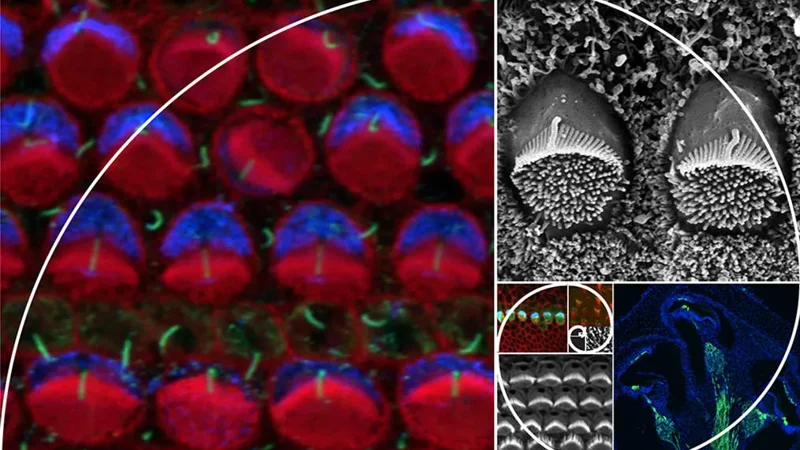
His team studies a portion of the hair cell known as the hair bundle — delicate, brush-like protrusions that sprout from the cell’s surface and are deflected by sound. During the process of human development, these protrusions arrange themselves in a “staircase structure” of short-to-tall gradations to capture sound vibrations and convert them into electrical signals that the brain can interpret.
One focus of the Tarchini lab is to look at proteins that elongate the protrusions during development. When these proteins are removed in mouse models, the protrusions remain stunted, resulting in profound deafness. This developmental defect mirrors genetic hearing loss in families around the world, where inherited variants in the same proteins lead to deafness at birth.
Their findings, however, extend beyond inherited forms of hearing loss. In a recent discovery, Tarchini's lab observed that these proteins stay in place, positioned at the tip of the protrusions, even after development is complete. There, the proteins have a maintenance role — and could possibly even function as a repair mechanism — into the advanced stages of life.
“Since we have the tools and expertise to address how our sense of hearing develops in the early stages, we are well-positioned to shift focus and address how it changes with age or damage,” Tarchini said. “The beauty of science is that sometimes your results lead the way for you.”
Solutions powered by research
Tarchini’s work is part of a larger shift from engineered tools for hearing loss, such as hearing aids and cochlear implants, to biological solutions like the first-ever gene therapy for hereditary hearing loss that realized the potential for personalized medicine in the field. He noted that real progress takes time; behind every headline is decades of trial and error, risk and failure.
“The real breakthroughs happen behind the scenes,” he said. “The therapies we benefit from today didn’t happen magically. They are born from painstaking and often overlooked experimental work in the lab, a steady effort that ultimately leads to life-changing discoveries.”
Learn more
The Tarchini Lab - The Jackson Laboratory
Investigating the genetics and cell biology of hearing and balance.
View moreLoading...