The Jackson Laboratory

Lysosomal Storage Disorders Mouse Models and Efficacy Studies

Lysosomal storage diseases (LSDs) are a group of rare, heritable disorders caused by defective or deficient lysosomal enzymes which are critical for processing of molecules in the cell. The lysosomes play a key role in the normal processing of proteins, fats, carbohydrates and nucleic acids, as well as removal of cell waste. They also contribute to cell defense in the destruction of bacteria and viruses taken in by the cell. Defects in any of these functions can lead to build up of toxic substances in cells and contribute to dysfunction and disease in the nervous system, musculature, and organs throughout the body.

JAX offers a robust portfolio of mouse models and services for LSD research, including Krabbe, Niemann-Pick, and Pompe disease, supporting rare disease and metabolic disease researchers.

Partner with JAX to Support Your Research

The Jackson Laboratory - Lysosomal Storage Disorders Mouse Models and Efficacy Studies

JAX LSD Models

Common Strain Name

Disease
Gene TargetPhenotypeDisease LatencyDetails

Twitcher
(000845)
Krabbe Disease

Galc

  • Abnormal locomotor coordination
 
  • Demyelination in spinal cord
  • Decreased nerve conduction velocity
  • Survival < 2 months

npcnih
(003092)
Niemann-Pick Disease

Npc1

  • Abnormal locomotion

1 month

  • Survival < 3 months
  • Abnormal nerve conduction velocity & CMAP
  • Neuroinflammation

6neo
(004154)
Pompe Disease

Gaa

  • Progressive accumulation of lysosomal glycogen in several tissues

1 month

  • Reduced mobility and progressive muscle weakness
  • Cardiomyopathy

Lysosomal Storage Disease Studies with JAX

JAX offers preclinical services to support research for lysosomal storage diseases, including Krabbe, Niemann-Pick, and Pompe disease. Leveraging our well-characterized LSD mouse models, our scientific teams design and execute custom study protocols.

Available study readouts include:

  • Muscle electrophysiology
  • Neuroscore, body weight, survival, clinical observation
  • Globoid cells and demyelination
  • Rotarod, inverted wire hang
  • Nerve conduction velocity (NCV)
  • Bird scoring (qualitative assessment of mobility, gait, hindlimb clasping, tremors, breathing)

Consult with JAX About Running Your LSD Study

Customizable Preclinical Efficacy Studies for LSD Studies

Study variables differ depending on your model of choice and research needs.
Below is a sample study:

TimelineDepending on model
GroupsTypical n per group: N=12, mixed sex
In vivo Readouts

Once

  • IV Dosing

Weekly (or 2x weekly)

  • Body weight
  • Neuroscore
  • Clinical Observation

3 Time Points

  • Rotarod
  • Open field

Other

  • Blood collection (once pre-dose)
  • Nerve conduction velocity
Daily DosingOptions: IP/PO/SC/IV
Post Mortem
  • Tissue Collection (including DRGs)
  • Cardiac Puncture (Serum/plasma)
  • Data Summary
  • Shipment of Samples and Slides

Example of Efficacy Study Data

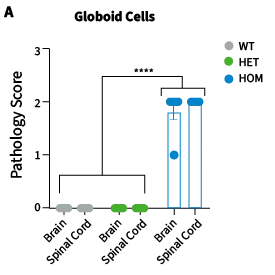
Krabbe Disease Model: B6.CE-Galc^twi/J 000845 - Quantification of globoid cell accumulation scored on a pathology scale (0-3). Globoid cells are absent in WT and HET tissue but markedly elevated in both brain and spinal cord of HOM animals.
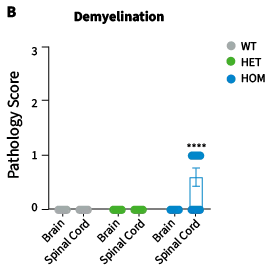
Krabbe Disease Model: B6.CE-Galc^twi/J 000845 - Quantification of demyelination in brain and spinal cord tissue from wild-type (WT, gray), heterozygous (HET, green), and homozygous twitcher (HOM, blue) mice, scored on a pathology scale (0-3). Demyelination is minimal in WT and HET mice but significantly increased in HOM spinal cord.

Krabbe Disease Model: B6.CE-Galctwi/J 000845

Quantification of (A) globoid cell accumulation and (B) demyelination in brain and spinal cord tissue from wild-type (WT, gray), heterozygous (HET, green), and homozygous twitcher (HOM, blue) mice, scored on a pathology scale (0-3). Globoid cells are absent in WT and HET tissue but markedly elevated in both brain and spinal cord of HOM animals. Demyelination is minimal in WT and HET mice but significantly increased in HOM spinal cord.
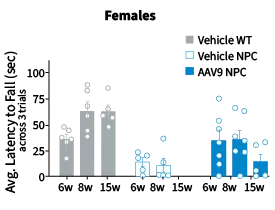
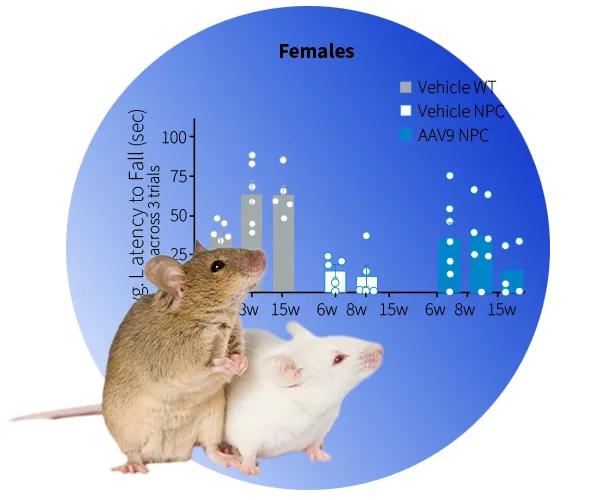
Niemann-Pick Disease Model: BALB/cNctr-Npc1^m1N/J 003092 - Average latency to fall (sec, mean ± SEM across 3 trials) on an accelerating rotarod, assessed in females at 6, 8, and 15 weeks of age. Groups include vehicle-treated wild-type controls (gray), vehicle-treated NPC mice (open blue), and AAV9-treated NPC mice (filled blue). Vehicle-treated NPC animals show progressive motor decline relative to wild-type controls with age, while AAV9 treatment partially preserves motor performance at 6 and 8 weeks in both sexes.
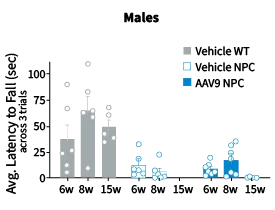
Niemann-Pick Disease Model: BALB/cNctr-Npc1^m1N/J 003092 - Average latency to fall (sec, mean ± SEM across 3 trials) on an accelerating rotarod, assessed in males at 6, 8, and 15 weeks of age. Groups include vehicle-treated wild-type controls (gray), vehicle-treated NPC mice (open blue), and AAV9-treated NPC mice (filled blue). Vehicle-treated NPC animals show progressive motor decline relative to wild-type controls with age, while AAV9 treatment partially preserves motor performance at 6 and 8 weeks in both sexes.

Niemann-Pick Disease Model: BALB/cNctr-Npc1m1N/J 003092

Average latency to fall (sec, mean ± SEM across 3 trials) on an accelerating rotarod, assessed in (left) females and (right) males at 6, 8, and 15 weeks of age. Groups include vehicle-treated wild-type controls (gray), vehicle-treated NPC mice (open blue), and AAV9-treated NPC mice (filled blue). Vehicle-treated NPC animals show progressive motor decline relative to wild-type controls with age, while AAV9 treatment partially preserves motor performance at 6 and 8 weeks in both sexes.

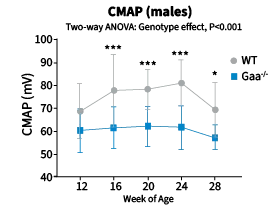
Pompe Model: B6;129-Gaa^tm1Rabn/J 004154 - CMAP amplitude (mV, mean ± SD) measured longitudinally from 12 to 28 weeks of age in wild-type (gray) and Gaa^tm1Rabn (blue) male mice. CMAP is consistently reduced in Gaa^tm1Rabn mice relative to wild-type controls across all timepoints in both sexes, consistent with progressive neuromuscular dysfunction.
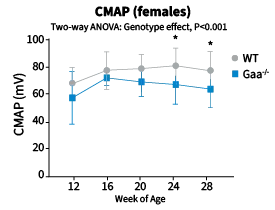
Pompe Model: B6;129-Gaa^tm1Rabn/J 004154 - CMAP amplitude (mV, mean ± SD) measured longitudinally from 12 to 28 weeks of age in wild-type (gray) and Gaa^tm1Rabn (blue) female mice. CMAP is consistently reduced in Gaa^tm1Rabn mice relative to wild-type controls across all timepoints in both sexes, consistent with progressive neuromuscular dysfunction.

Pompe Model: B6;129-Gaatm1Rabn/J 004154

CMAP amplitude (mV, mean ± SD) measured longitudinally from 12 to 28 weeks of age in wild-type (gray) and Gaatm1Rabn (blue) mice, shown separately by sex (left and right panels, presumed male/female). CMAP is consistently reduced in Gaatm1Rabn mice relative to wild-type controls across all timepoints in both sexes, consistent with progressive neuromuscular dysfunction.

FAQs for Lysosomal Storage Disease Models

Discover More

Overcoming Challenges in Preclinical Gene Therapy Testing for Neurological Diseases

Watch this webinar to hear from JAX's In Vivo Services team on how our well-characterized, clinically relevant models and custom research assays can help you overcome key challenges in gene therapy development. The team shares case studies demonstrating how JAX's platforms have successfully supported gene therapy programs from early discovery through IND-enabling studies.

Watch Now

Not what you're looking for? Find more resources

Visit our Resource Hub

The Jackson Laboratory - Overcoming Challenges in Preclinical Gene Therapy Testing for Neurological Diseases

Sign Up | JAX Pulse
Stay informed about our events, blogs and videos, and cutting-edge research platforms.

©2026 The Jackson Laboratory