
By Roberto Molar Candanosa
Article | September 23, 2026
In 2025, scientists from The Jackson Laboratory (JAX), the Broad Institute, and other organizations corrected mutations behind an ultra-rare neurological disease by editing DNA directly in the brains of mice. In 2026, the same researchers used a similar approach to fix a mutation causing another extremely rare liver disease, this time in mouse models and human patient cells. Their work builds on the approach used to create the first personalized treatment to directly edit a patient’s DNA, given to Baby KJ Muldoon for a life-threatening genetic disorder.
Now, the researchers are pushing to make gene editing for rare diseases less of a one-off breakthrough and more of a repeatable medical approach that others can adopt. But what exactly is gene editing, and how do scientists make targeted changes to DNA?
“When there is an error in the DNA, we can go straight into the DNA and correct it to what it was supposed to be,” said Markus Terrey, a neuroscientist at JAX’s Rare Disease Translational Center (RDTC) and co-author of the 2025 study. “But we are not changing a whole gene in the sense that we are rewriting the whole gene. It's usually just a few DNA letters that we are changing, but as a consequence the whole gene functions the way it's supposed to.”
What does it mean to “edit” a gene?
DNA is like an enormous set of molecular instructions written in a four-letter chemical alphabet: adenine (A), thymine (T), cytosine (C), and guanine (G). A gene is a stretch of DNA that carries these instructions for making a functional product, often a protein. When scientists edit a gene, they make specific changes to those instructions, like correcting a typo in a book with billions of letters.
After finding the particular stretch of DNA in question, scientists can cut, remove, add or alter genetic material at that location. That can mean disrupting a gene, changing a single DNA letter, or making a more complex correction. For rare genetic diseases, where a single mutation can cause devastating consequences, these targeted changes could potentially address the underlying cause of disease.
CRISPR and beyond: New ways to edit DNA
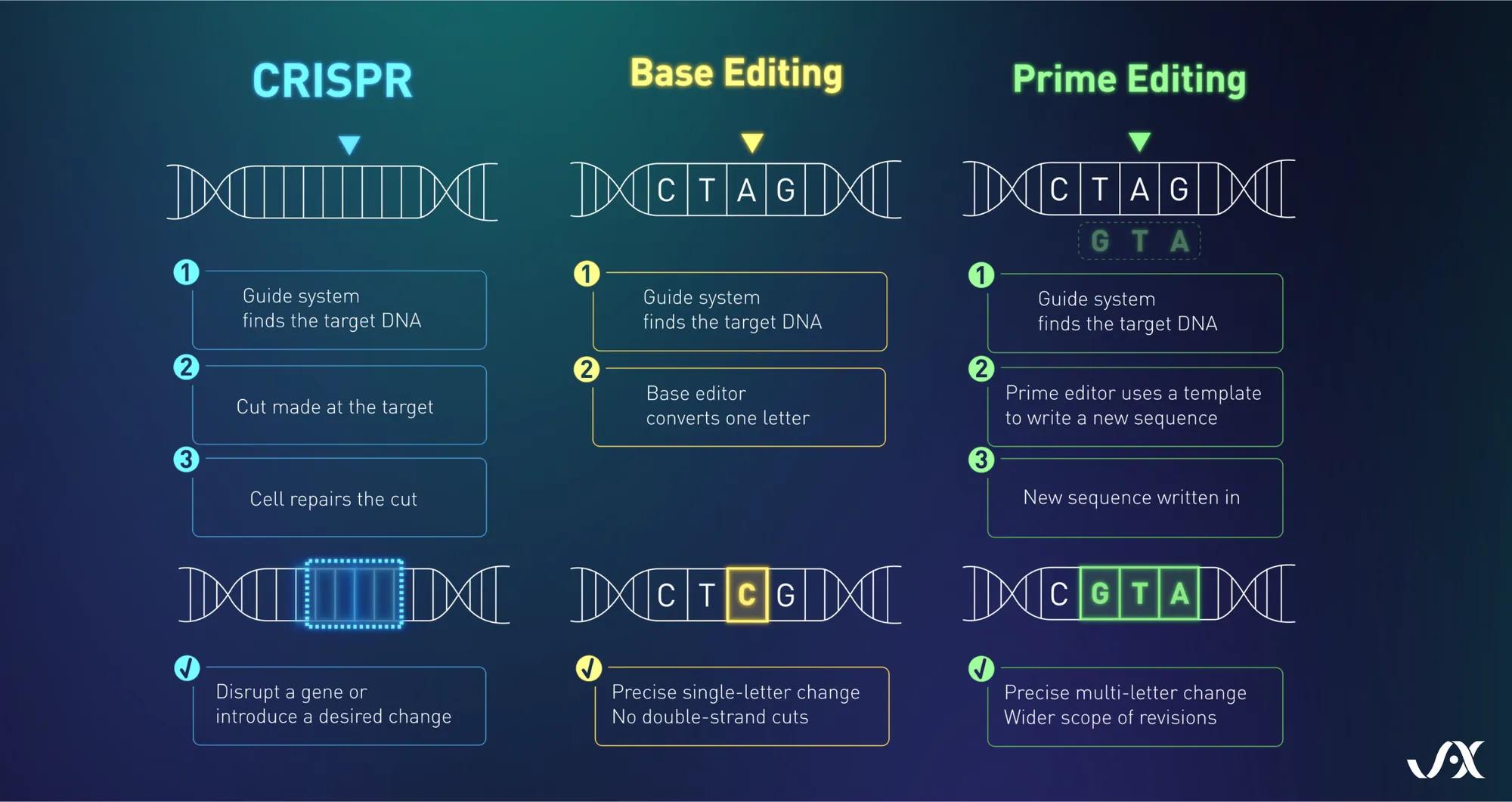
Researchers developed the first gene editing technologies in the late 1900s, but a new tool called CRISPR-Cas9 made the process dramatically easier in the early 2010s. It uses a molecule called a guide RNA that directs the Cas9 protein to a matching DNA sequence. Cas9 then cuts both strands of the DNA molecule, and the cell repairs the break. Scientists can harness that repair to disrupt a gene or introduce a desired change. But those cuts can also create unintended changes, a particular concern when many genetic diseases come down to something as small as a single-letter mistake in DNA.
Base editing: Correcting one letter at a time
To address this concern, scientists developed a newer, CRISPR-based tool called “base” editing. It can convert certain DNA letters into other letters without making the double-stranded breaks used in conventional CRISPR. It does this using an enzyme that alters the chemical structure of specific DNA bases. In other words, if CRISPR works like molecular scissors, base editing is closer to a pencil that rewrites one letter.
When JAX and Broad researchers successfully repaired a mutation in the PEX1 gene associated with Zellweger spectrum disorder (ZSD) in April, they used base editing to change a single DNA letter linked to the life-threatening disorder. They used the same approach to correct a mutation causing Dravet syndrome (DS), a rare and potentially deadly form of childhood epilepsy.
Prime editing: Making bigger corrections to DNA
Current base editors support particular chemical conversions, with the classic ones performing A-to-G, or C-to-T changes, but they don't cover the full spectrum of possible single-base substitutions. Therefore, when a genetic change can't be addressed with base editing, researchers can turn to another CRISPR-based technology called “prime” editing.
“Because we have four letters, you cannot automatically correct every mutation that exists. There will simply be mutations that you cannot correct,” Terrey said. “Prime editing does not rely on correcting a single nucleotide. It can correct multiple nucleotides because it basically rewrites a small portion of the DNA.”
Prime editing can make a broader range of precise changes, including substitutions, small insertions, and deletions. It uses a modified CRISPR protein to make a small cut, or nick, in only one strand of DNA. This allows an RNA template to write the desired DNA change into the target site. Where CRISPR cuts DNA and lets the cell repair it, and base editing changes individual DNA letters, prime editing functions more like the “find and replace” tool in Microsoft Word.
In their 2025 study, Terrey’s team used prime editing to correct mutations in the ATP1A3 gene that cause alternating hemiplegia of childhood (AHC). A single injection into the brains of mice corrected up to 85% of the targeted mutations in some areas of the brain. The approach remains preclinical and has not yet been tested as a treatment in people. For now, base editing is often the more practical option because it has already reached the clinic, Terrey said.
“Maybe in two or three years, when we have more data from the clinic and people are more comfortable with the technology, prime editing would have the potential to address a much broader range of mutations compared to the more common clinical application of base editing,” Terrey said.
From editing DNA to treating disease
Base and prime editing are opening the door to more personalized treatments for rare diseases. At JAX, researchers are exploring gene editing primarily for children with severe genetic diseases, where identifying the underlying mutation early could create an opportunity to intervene before years of damage have occurred.
“This is about more than correcting a single mutation,” said RDTC Vice President Cathleen (Cat) Lutz, a co-senior author in the DS, ZSD and AHC studies. “It’s about building a new paradigm for how we develop genetic therapies, one that starts with precise disease models, scales through platform technologies like base editing, and ultimately reaches patients faster.”
Building a repeatable path to treatment
In July, the RDTC helped launch the Center for Therapeutic Genetics (CTG) with teams from the Broad Institute and Boston Children’s Hospital to develop precision genetic medicines and build repeatable tools for treating rare diseases. A month later, they co-authored a Nature Biotechnology study describing OptiPrime, an AI model that predicts which guide RNAs are most likely to efficiently make a desired edit, potentially making prime editing easier to develop and reducing the need to test hundreds of strategies in the lab and highlighted the process of efficient in vivo correction for an additional neurological condition known as KAND.
Still, the progression from CRISPR to base and prime editing isn’t a search for one best tool. Each offers a different way to make targeted DNA changes. The goal is to make genetic medicine an approach that can be used far more broadly.
“We are at a moment in genomic medicine where, for many rare diseases, the question is no longer whether we can treat them, but whether we will build the systems to do it. CTG answers that call,” said Lutz, co-founder of the center.
Animations: Caroline Bennett, The Jackson Laboratory
Support rare disease research
Your gift helps accelerate the search for answers for people living with rare diseases, transforming genetic discoveries into better diagnostics, treatments and hope.
Learn more

Rare Disease
While each rare disease affects only a small number of people, together they impact millions and offer clues about how biology works.
View more
Education mini-course: CRISPR as a genomic therapy
This MiniCourse is self-paced and takes about one hour to complete. At the end of the MiniCourse, you will be able to evaluate strategies for using CRISPR to treat a genetic disease.