
What makes us live longer… and how do we know?
Article | July 30, 2026

From different foods to hormones to new drug treatments, there are lots of ideas for ways to help people live longer.
But determining what truly works requires careful, long-term testing. In 2003 the NIH's National Institute of Aging established the ITP to standardize aging research. Now more than 20 years old, the program is considered the "gold standard" for testing aging interventions.
How it used to work
Lack of coordination yielded unreliable, non‑reproducible and, at times, contradictory results.
- No communication across testing sites
- Inconsistent animal models
- Environmental differences
- Small sample sizes
- Different study designs
How it works today
The ITP is made up of the University of Texas Health Science Center, University of Michigan, and The Jackson Laboratory, who all have identical protocols and standards. The ITP yields reliable, reproducible results that further scientific discovery in aging research.
- A coordinated effort across the three testing sites
- Standardized population of genetically diverse mice to mimic the human population
- Controlled environmental parameters
- Large-scale sample sets
- Researchers measure lifespan, disease incidence
What is an intervention?
Any treatment or change applied to an organism to see if it alters aging lifespan, or health outcomes.
What kinds of things are tested?
Compounds selected for testing show early promise in aging research or are strongly supported by scientific evidence. Many are existing drugs originally developed for other conditions but may also target pathways involved in aging.
These interventions include:
- Pharmaceuticals
- Dietary compounds
- Hormonal agents
- Metabolic regulators
The ITP process
STEP 1 Scientists propose compounds that may influence aging.
STEP 2 A committee selects the strongest intervention proposals for that year.
STEP 3 Short pilot studies are conducted of the proposed interventions.
STEP 4 Standardized testing begins simultaneously at the three ITP sites.
STEP 5 Expansive sets of genetically diverse mice are monitored across their lives comparing those treated with interventions and those without.
STEP 6 As a group, the ITP publishes the findings of each intervention study.
Success story
Since it was founded in 2003, the ITP has identified more than 15 compounds that extend lifespan in mice. In a landmark 2009 study, researchers showed that rapamycin (an FDA‑approved immunosuppressant for organ transplant patients) can significantly increase lifespan even when treatment begins later in life.
This discovery helped redefine what’s possible in aging research and opened new paths toward improving human healthspan.
Learn more

Aging
JAX researchers are working to understand the biological mechanisms that allow some individuals to remain healthier longer.
View more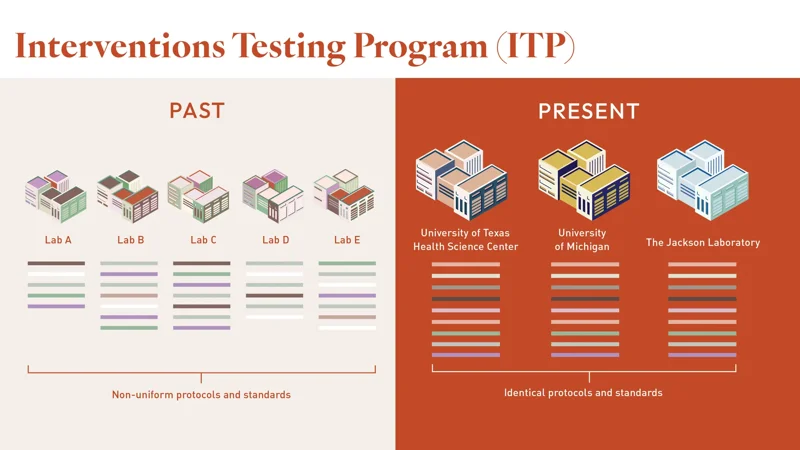
Interventions Testing Program (ITP) - JAX Aging Center
The National Institute on Aging’s (NIA) Interventions Testing Program (ITP) is a multi-site collaborative project.
View more