
Q&A | Using data to move Alzheimer’s research forward
Article | February 10, 2026
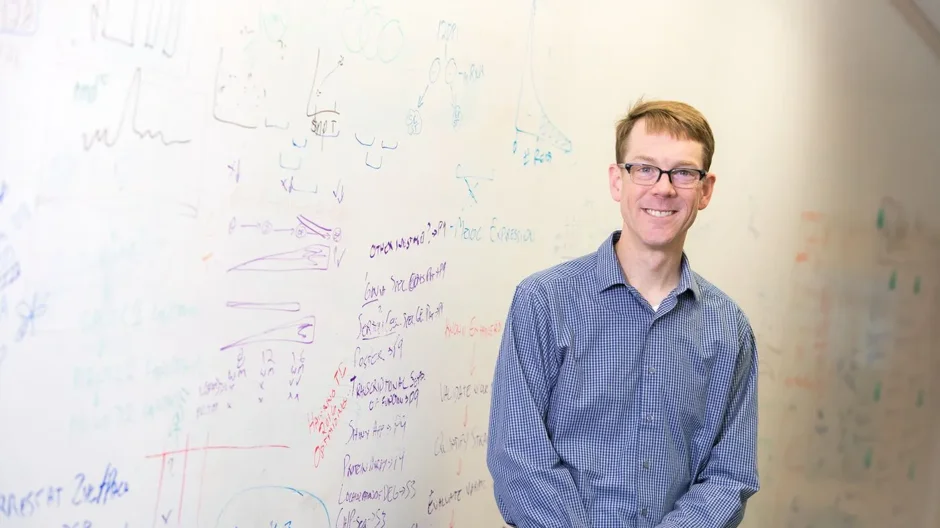
Alzheimer’s disease is the sixth leading cause of death in the United States, yet it is still poorly understood despite its huge costs and burden. We sat down with JAX Professor and Bernard and Lusia Milch Endowed Chair Greg Carter, who is working at the intersection between patients and non-human primate, mouse, and cell models to help develop potential therapies for Alzheimer’s.
His team uses data to strengthen the interface between experimental systems and common diseases in humans, developing computational methods to analyze complex data and design translatable studies of model systems that are shared with the wider scientific community. The work involves mapping networks of interacting genes, integrating phenotypic and molecular data, critically evaluating models with experimental tests, and exploring how biological complexity is encoded in genetic data.
What is the core focus of your lab, and how do you approach Alzheimer’s research?
I run a computational biology lab. We study Alzheimer’s disease in mice, cell models, and non-human primates, and we also use a lot of human data for early-stage drug discovery and target prioritization. My lab basically functions as the computational data analytics hub for all of this information. We sit in this big tornado of data and try to shape it into a consistent model of dementia. We bring in data from all these sources, combine it, try to use it most effectively—mostly applied to drug development and drug testing.
This work is organized into large multi-institution projects where I serve as a lead PI and data science head. These include the Model Organism Development and Evaluation for Late-onset Alzheimer’s Disease (MODEL-AD) Consortium to create new mouse models, the MARMO-AD Consortium to study aging and dementia in marmosets, the MicroPhysiological Systems for Alzheimer’s Disease (MPS-AD) Consortium to use cell and organoid models, and the TREAT-AD Consortium to identify and develop new drug targets from innovative data streams. Altogether we collaborate with 15 fellow institutions on these projects.
What makes Alzheimer’s such a difficult disease to study?
Alzheimer’s is a hard disease. We can’t study brains until after the donors are deceased. So, if you’re trying to study a disease that develops over decades in a tissue that you can never access, you tend to rely very heavily on your animal models. And in the past, those models haven’t been entirely successful. Mice don’t develop the same brain atrophy. That’s what kills you if you have Alzheimer’s—that’s what wipes out your hippocampus and destroys your memories. It’s very easy to fill a mouse brain with amyloid plaques, and it’s pretty easy to fix that in a mouse. But the amyloid doesn’t trigger cell death on the scale that you see in humans. Nobody knows why—mice are just resilient.
Mice don’t fully get Alzheimer’s is the bottom line, and so we've tried to use data to bridge those knowledge gaps as much as we possibly can. No single model is going to solve this disease. That’s why it’s important to set things up so we can directly compare across systems. The goal is not to replace one model with another—it’s to understand where each one is effective and use them to their best potential.
You’re part of a new grant from the National Institutes of Health focused on discovering if organoids are useful models for preclinical development and drug development and testing for Alzheimer’s. Can you share a little bit about that work and what you’re hoping to find out?
It’s a partnership between JAX, Brigham and Women’s Hospital, and JAX-NYSCF Collaborative, with the goal of asking a very basic but important question: how useful are organoid and cell-based models for preclinical development and drug testing in Alzheimer’s? We’re working with several different platforms, including simple 2D neuron–glia cultures, 3D organoid-style systems, and more complex vascularized “miBrain” models that are designed to be more physiologically relevant. The idea is to characterize these models, test how well they work at scale, and see whether they’re actually predictive in ways that matter for drug development.
A big part of this is scale and comparison. Using cells derived from about 100 human donors with extensive lifetime and postmortem data, we can ask how genetic background and specific molecular features influence response to treatment. Not everybody with Alzheimer’s has the same underlying pathology, and these models give us a way to test those biological differences directly. The promise is huge, but nobody really knows yet how translatable these systems are—so this grant is really about doing the work to find out.
Do genetics and molecular differences play that big of a difference in determining who might respond to certain Alzheimer’s treatments?
There are a lot of dementias that end up being thrown into the Alzheimer’s bucket, primarily for diagnostic reasons. For the patient and the family, they’re similar enough as far as symptoms go, but under the hood, they are very different. One could be a vascular disease, another a white matter disease, and while the symptoms are similar, the treatments would vary widely.
One of the big things we’re trying to do is figure out whether there are subgroups of individuals that are going to be better treated by certain therapeutic targets. We can ask questions like: what does genetic background have to do with response to a treatment? Not everybody with Alzheimer’s has the same molecular deficiencies. If we can target the subset of people who actually do, that’s where things get interesting. Because if you can figure out what those causal links are—X thing happens in the brain, so you see Y thing in the blood—that could be diagnostic. That’s really where the field is going.
Where do you think the field of Alzheimer’s research is headed?
Blood biomarkers are by far the most exciting thing in Alzheimer’s research right now. The FDA just approved one biomarker for Alzheimer’s. It’s a special type of tau protein. Tau proteins are naturally occurring proteins that help stabilize the structure of neurons in the brain, and the new blood biomarker test is aimed at identifying how a specific form of tau changes in older adults. These Tau forms are what actually accumulates in neurons and likely leads to cell death.
We’re pushing this blood biomarker research now with animal models, because we can look at biomarkers across the entire lifespan, as opposed to human studies, which tend to start with 60-70 year olds because that’s where you see the disease. To wind back and look at midlife biomarker changes and trajectories is not easy, because you probably won’t see the same proteins changing in the blood that are changing in the brain. But if you can figure out the causal links—this happens in the brain, so you see this other thing in the blood—that could be diagnostic, and that’s where the field is going. If we can have blood biomarkers in a 55-year-old that tell you you’re at high risk for Alzheimer’s, of course that would be incredibly valuable.
Learn more
MODEL-AD drives progress for Alzheimer’s disease research - The Jackson Laboratory
The Jackson Laboratory's MODEL-AD Consortium is advancing research by developing mouse models that better represent human Alzheimer's disease, focusing on late-onset forms.
View more