
From science to history and back again
Article | February 5, 2026
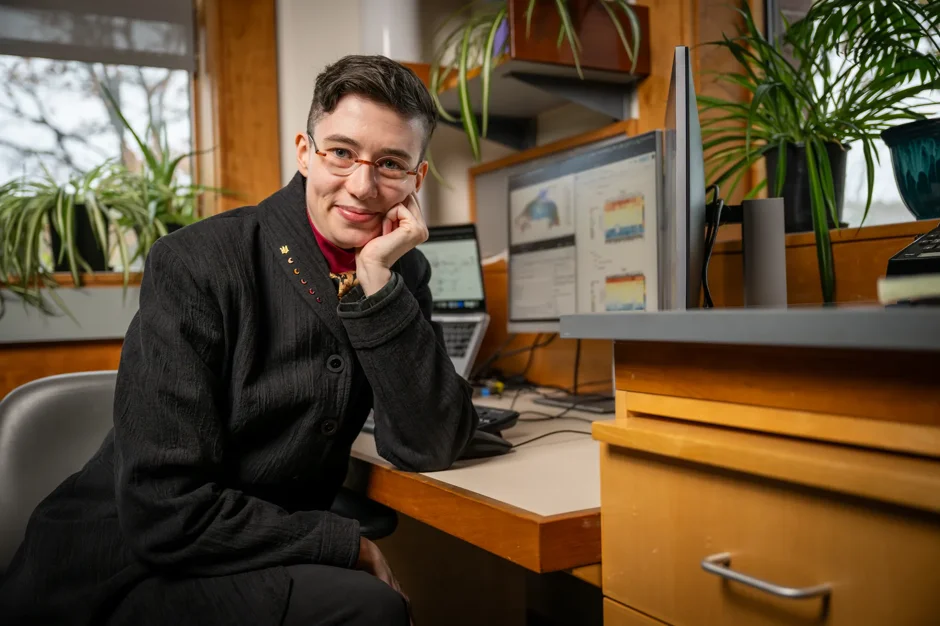
Lauren Kuffler, a postdoctoral associate in the Baker Lab at JAX, comes from a family steeped in science.
Their grandfather, Stephen Kuffler, was a renowned neurobiologist known as the “Father of Modern Neuroscience.” Their uncle, Damian Kuffler, works in the same field and recently published his research on a new surgical technique to eliminate nerve pain from old injuries. And as a physician at Mount Desert Island Hospital, their father, Julien Kuffler, was often shadowed by JAX postbaccalaureate fellows.
Kuffler completed high school internships at JAX and the Mount Desert Island Biological Laboratory before taking a break from science to obtain their undergraduate degree in medieval and renaissance studies.
“I love history and I love languages,” Kuffler said, “and those can certainly help society in many ways, but I wanted to have more direct effect. I wanted to use my skills to help people.”
Warding off disease at the start
Compared to other mammals, humans develop fast. Our speedy nine-month gestation reflects the demands of evolution: bigger brains, two legs instead of four, and a smaller pelvic structure tailored to hold a being that will eventually walk upright.
Our cells, therefore, grow and divide quickly in utero. Kuffler investigates the timing of these processes in mouse embryoid bodies (a collection of embryonic stem cells in a dish) to better understand their implications for humans over time, as age-related diseases become more of a risk.
Some types of cells, such as neurons, develop early and only grow to a set amount, meaning that if injury or trauma depletes them, we can’t build them back up — which could leave some people more susceptible to conditions like Parkinson’s disease. Kuffler is interested in the systemic, big-picture causes of such health challenges.
“Everyone studies diseases,” Kuffler said. “They want to find out what’s broken and figure how to get back to ‘normal,’ but there are many different ways to be normal. I like studying how our biological pathways work together throughout development to make that variety possible.”
Rapid cell growth is necessary and risky
During early development, cells grow so fast that they sometimes don’t end up functioning as they should. As they prioritize growth and coordination with other cells, they also shut down the systemic quality control that is normally active when cells divide. Kuffler wants to find out what happens during these periods, and what the effects might be as one goes through life. Their work has implications for the way we think about fertility, regenerative medicine and age-related diseases.
Kuffler is also exploring variations in genomic stability that accompany rapid cell growth. Chromosomal instabilities known as aneuploidies, for example, could play a role in cancers that develop later in life. Kuffler recently took on a side project to study whales — mammals with a long lifespan that almost never develop cancer, even though they have much more tissue in which cancer could occur. Kuffler hopes to find out what we might learn from their biology about living longer, healthier human lives.
Freedom to ‘follow the science’
With a Ph.D. in mammalian genetics from Tufts University, Kuffler returned to JAX, and to their scientific roots. Amid an uncertain moment for scientific research and education, they are grateful for the chance to be surprised by their work — an opportunity that results from bold ideas, uncharted pathways and often the generous flexibility of private support. “In a project like ours, there are many different avenues and potential points of discovery,” they said. “Philanthropy allows you to follow the science even when it surprises you or takes you in a different direction than you intended. That’s where the real innovation happens. It may seem serendipitous, but it all comes from having the right people in the right place.”
Learn more
News and Insights - The Jackson Laboratory
Gain insights into bioscience, technology and the quest to improve human health.
View more
2025 Donor Impact Report
The year 2025 brought a myriad of moments to celebrate the connections that strengthen us — especially those in our generous community of donors like you.