
Building the next generation of genomic thinkers
Article | November 4, 2025
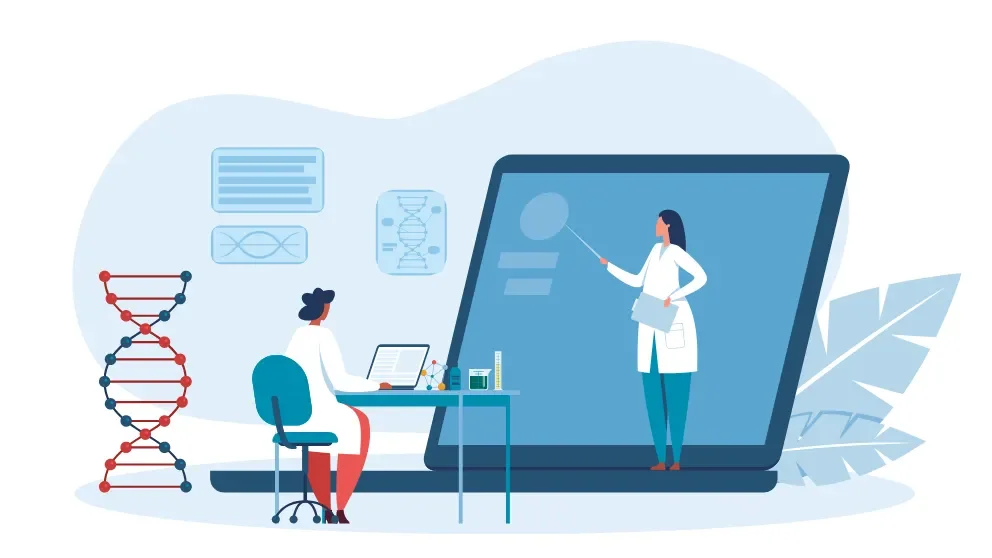
The era of precision medicine is here, transforming how doctors diagnose and treat patients across specialties. Discoveries in genomics have the potential to transform medicine, but many clinicians graduate without dedicated genomics training.
To close that knowledge gap, before these future health care providers even enter medical school, The Jackson Laboratory’s (JAX) Clinical Education team is collaborating with the University of New England (UNE). Designed for graduate students on the path to health care and biomedical research careers, the Applied Genomics virtual course offers a window into how genomic science can guide clinical decisions in the real world.
Offered through the University of New England’s online Master of Biomedical Sciences program, the Applied Genomics course, developed by JAX’s Clinical Education team, introduces students to the fundamentals of human genomics and its application in clinical practice.
“Despite the rapid pace of innovation in genomics and precision medicine, there are still big lags in patient access. A major reason for those gaps is simple: Many health care providers haven’t had adequate genetics education,” said JAX Director of Clinical Education Emily Edelman, a board-certified genetic counselor, who also teaches in the Applied Genomics course.
“We designed this course for students who are standing at the gateway to medicine — giving them a genomic lens before they even start professional school,” Edelman said.
Real-world examples in a flexible format
First launched in spring 2025 and now entering its third cohort, students explore real-world case scenarios in primary care, cardiology, oncology, and rare diseases. Many UNE students work full time, so the course is designed with flexible weekly assignments, feedback from instructors, and optional office hours for extra support. Each lesson blends foundational science with real-world applications, including patient videos, clinical case studies, and ethical discussions.
“We wanted to make it fun and engaging,” said Edelman. “These students care deeply about patient care, so we focus on stories and case examples that show how genomics impacts real people—and how it will continue to shape the future of medicine.”
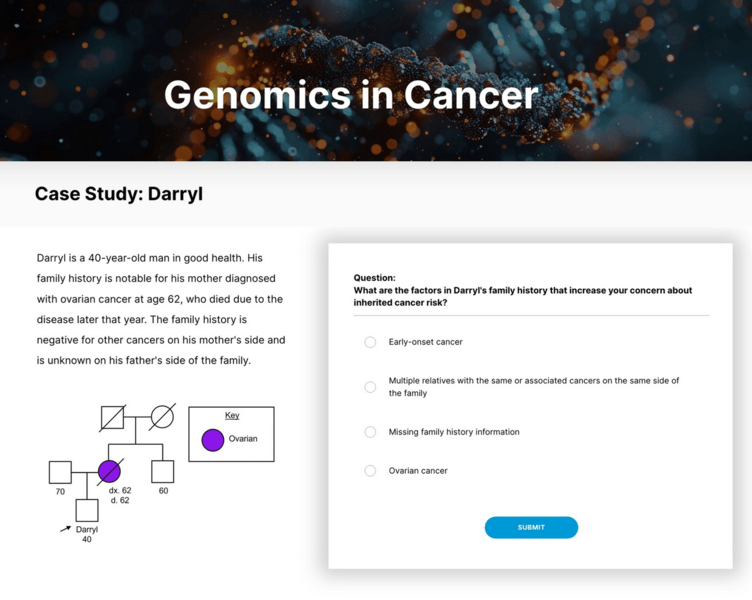
The program modules are designed to help students gain a deep appreciation for how genomics informs diagnosis, treatment, and the future of precision medicine. By utilizing real-life case studies, the students learn how to interpret actual test results and are taught to consider ethical questions around access and consent.
“This course positively and excitingly deepened my understanding of personalized medicine,” said Annika Mogck, a full-time student preparing to apply to medical school. “Personalized medicine is not just the future of health care, it’s already transforming lives, and as a future medical professional, I feel more inspired and prepared to be part of that change.”
Alexandru King, another student preparing for medical school, said the course expanded his appreciation of the breadth and depth of genomic specialists. King had worked in genomic and personalized medicine for three years before taking this course but said he still lacked a lot of the clinical exposure the course provided.
“Learning all the different avenues that genetic testing can open— pharmaceuticals, treatment options, its major role in cancer prognoses—further illuminated applications I'd heard of but hadn't seen in practice,” said King. He added that the course further solidified his belief “that genetic medicine has a firm place on the front lines of health care.”
Preparing clinicians for the future of medicine
The course launched in spring 2025 with just 12 students. By fall, enrollment had grown to 46—a strong signal that interest in applied genomics is rising.
Edelman sees this early success as part of a broader, long-term effort to prepare the next generation of health care professionals for a genomics-informed future.
“We now have 80 future health care providers who’ve had a positive, hands-on experience with JAX around integrating genetics into health care,” she said. “If we can keep multiplying that year after year—at UNE and beyond—we’re setting the foundation for clinicians who will be ready to apply genomics meaningfully in patient care.”
For the students, that future feels both exciting and attainable.
Karina Demchuk, a research assistant planning for a career in medicine, said the moment everything “clicked” was when she realized genomics can directly influence treatment. “Seeing how a single mutation can change a pathway, and how that knowledge guides therapies, made the concept of personalized medicine feel very concrete,” she said.
For Edelman and the JAX Clinical Education team, the future is clear. “Our goal is simple: to make sure that every future clinician understands genomics not as abstract science, but as a vital tool for patient care.”
Learn more
JAX and University of New England launch applied genomics course
The Jackson Laboratory and University of New England launch applied genomics course to advance personalized medicine.
View more
JAX Clinical Education
JAX Genomic education developed with input from experts and clinicians on the front lines and to ensure it is relevant to your clinical practice
View more