
Understanding the structure of a stem cell
December 17, 2025
What am I looking at?
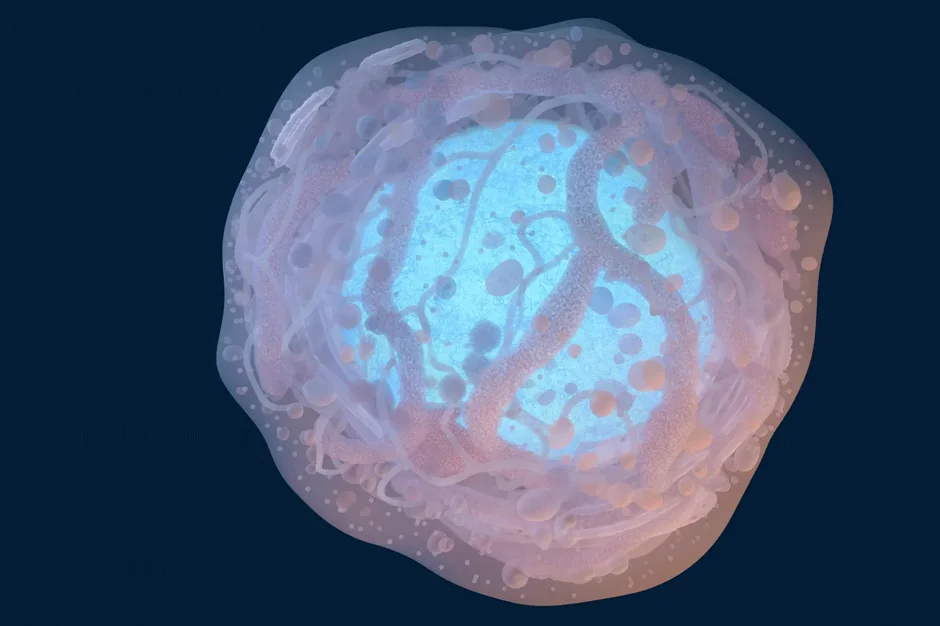
This 3D rendering reveals the intricate interior of a human stem cell, centered around a prominent blue nucleus. Surrounding it, the cytoplasm contains major organelles, including a branching network of mitochondria (maroon tubes) that extends throughout the cell. The rough endoplasmic reticulum lies closely against one side of the nuclear envelope, adjacent to a pink Golgi apparatus composed of curved cisternae (bottom right). Free ribosomes are dispersed across the cytosol alongside small vesicles such as lysosomes (pink spheres), peroxisomes, and endosomes. A far-reaching network of microtubules (thin pink lines) spans the cytoplasm, forming a supportive and organizing scaffold for cellular structure and transport.
How was this image created?
The 3D polygonal model was created in Autodesk Maya and Maxon ZBrush, using custom scripts and referencing volume image datasets from The Jackson Laboratory, Allen Institute for Cell Science, and other leading scientific institutions.
Human-derived stem cell models at The Jackson Laboratory
JAX brings gold-standard precision to human induced pluripotent stem cell (hiPSC) research. JAX offers a catalog of more than 650 engineered hiPSC lines on the well-established KOLF2.1J background, including gene knockouts, single-nucleotide variants paired with isogenic revertant controls, and specialized tools like HaloTag® lines for real-time insights into protein dynamics and Tet-inducible transcription factor lines for controlled differentiation into cortical neurons and microglia. These models enable robust and reproducible disease modeling, functional genomics, and scalable early drug discovery workflows.
With the upcoming integration of patient-derived hiPSCs through our 2025 acquisition of the New York Stem Cell Foundation, JAX will offer unparalleled access to both genetically engineered and patient-derived hiPSC lines. These resources allow direct comparison of variant effects in a shared genetic background and help assess how individual genetic differences influence disease phenotypes. Together, these resources reinforce JAX’s commitment to providing the global biomedical community with gold-standard, human-relevant models to accelerate discovery and help shape the future of precision medicine.
Learn more
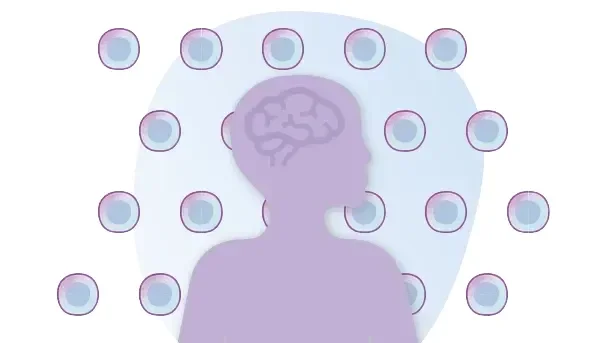
Human iPS Cells | The Jackson Laboratory
Explore The Jackson Laboratory’s catalog of high-efficiency human iPSC lines for Alzheimer's, ALS, and neurodegenerative research. Discover CRISPR-edited human iPS cells, revertant controls, and tools for precise disease modeling.
View more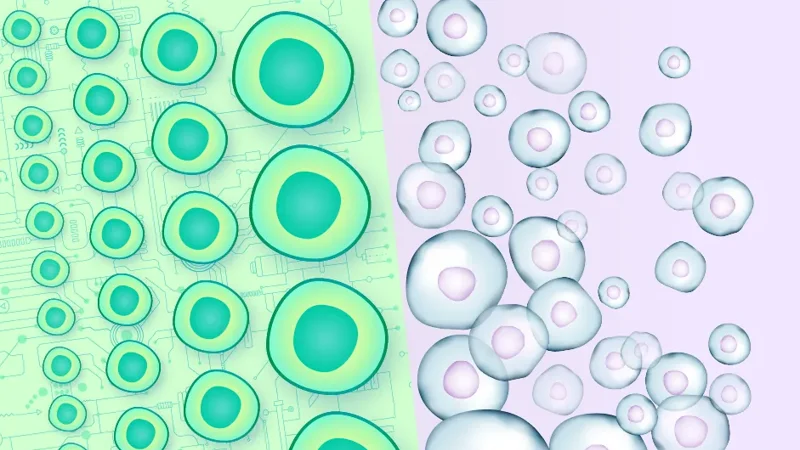
Engineered vs. Patient-Derived iPSCs: Strengths, Limitations, and Applications
Induced pluripotent stem cells (iPSCs) have become a cornerstone of modern biomedical research, offering unprecedented opportunities to model human development, investigate disease mechanisms, and...