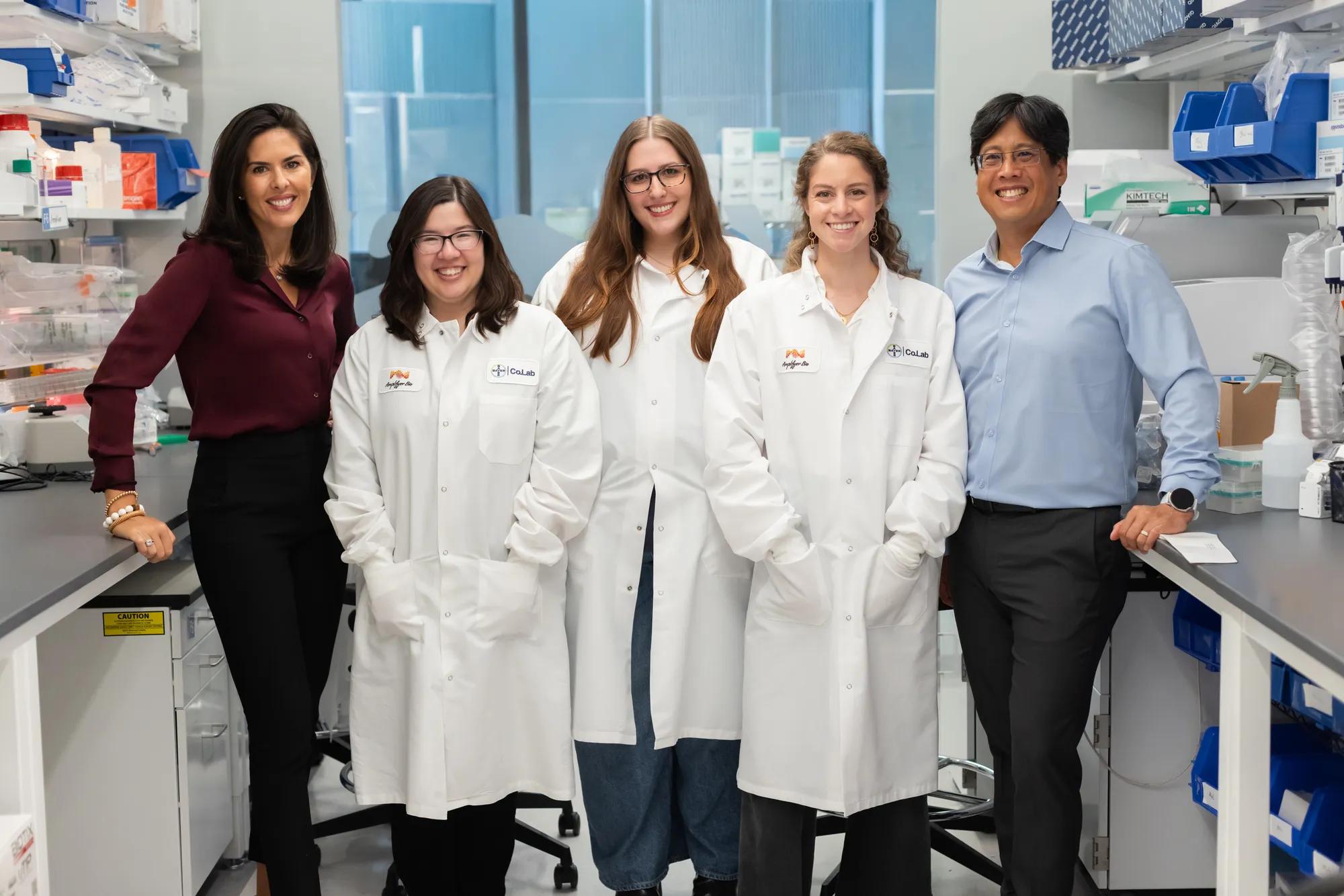
Amplifyer Bio is developing first-in-class "priming agents" that make cancer detection dramatically more sensitive and clinically actionable by boosting the tumor DNA recovered from a blood draw. Their team was selected by the JAX Preclinical Services Team as the recipient of our $15,000 grant, in support of an outstanding project proposal incorporating the HuPK™ (humanized FcRn) Platform.
Liquid biopsies enable noninvasive diagnosis, disease monitoring, and molecular profiling from a blood draw. In oncology, tests leveraging circulating tumor DNA (ctDNA) - cell-free DNA (cfDNA) fragments shed by tumors that carry actionable genomic information - are transforming cancer management. However, clinical utility remains constrained by the low abundance of ctDNA in circulation, leading to high false-negative rates that limit widespread clinical adoption, especially for early-stage and minimal residual disease detection.
To address this fundamental sensitivity bottleneck, in our seminal 2024 publication in Science we introduced a new class of diagnostic agents termed "priming agents". Similar to contrast agents used routinely for imaging, “priming agents” are designed to be administered prior to a blood draw and improve downstream test sensitivity. Amplifyer Bio was founded out of MIT and the Broad Institute to translate priming agents into clinical practice, and is based at the Bayer Co.Lab incubator in Kendall Square, Cambridge, MA.
Our lead candidate, AMP-001, is a fully humanized engineered antibody that shields cfDNA from clearance, inducing a transient accumulation that enables recovery of up to 100-fold higher ctDNA levels from a standard blood draw, drastically improving test sensitivity. Since priming efficacy is directly dependent on the duration of cfDNA shielding in circulation, antibody half-life is central to our mechanism of action. We have developed and validated a target-mediated drug disposition (TMDD) model in C57BL/6 mice that predicts cfDNA accumulation post-dosing as a function of binding affinity and antibody half-life. However, murine FcRn differs substantially from human FcRn in IgG recycling kinetics, making Tg32-based PK data essential for accurate allometric scaling to humans - and a critical milestone on the path to our first-in-human (FIH) trial planned for 2027.
The proposed study herein would characterize PK of two candidates - our lead molecule (AMP-001) and a back-up with distinct priming properties - across three dose levels in Tg32 homozygous mice, with longitudinal blood collection at 11 timepoints (5 min, 1h, 2h, 4h, 8h, 24h, 48h, 72h, 1w, 2w, 3w) and quantification by hIgG ELISA. The study comprises n=24 mice (2 molecules x 3 doses x 4 mice/group). PK parameters (t½, CL, Vd, AUC) will be integrated with pharmacodynamic cfDNA profiles collected at Amplifyer Bio to parameterize the TMDD model and allometrically scale doses to humans.
We see this project as the beginning of a sustained collaboration with JAX. Immediate follow-on studies include lower-dose PK characterization and subcutaneous dosing arms, for which we would leverage JAX's ultra-sensitive MSD readout. JAX's Tg32 platform, deep PK expertise, MSD capability, and scientifically curious approach to CRO partnership make it uniquely positioned to help us de-risk this milestone and serve as a thought partner as we interpret results and chart the path to our 2027 FIH trial - and, ultimately, to a future where a simple blood draw is sufficient to detect disease in oncology and beyond.
Thank you to all who submitted an entry and abstract!